06 December 2006

The Knee - To 'KNOW' or not to 'know'

From a friend: "To quote my son, 'I'm a militant agnostic': 'I don't know and YOU DON'T KNOW EITHER!!'" So, to KNOW or not to know, is this the Question?

Last night's reading- art historian Carl Schuster's amazing "Patterns That Connect", isbn 0810963264, page 190-3, "Legitimation: Return to the Male Womb"-

"The word for 'knee' is used in kinship terminology thoughout many languages, including all or most Indo-European languages. . .for ideas like 'degree of kinship' or 'generation'. . .and can be traced back to the homonymy of two Indo-European roots: the nominal root *g'en for the 'knee' and the verbal root *g'en-, which seems to mean 'beget'."

"The homonymy of these roots leads to such correspondences as that between the Latin 'genu' for 'knee' and 'genus' for 'decent'. [The Greek writer] Euripideas refers to knees as 'generative members' and the knee was commonly refered to as the seat of paternity."

This last quote of Schuster's is as close in this essay as he gets to suggesting that the 'knee', 'thigh' and 'foot' are phallic euphemisms. - see my earlier blog:

(Though Schuster does later quote Hebrews 7.10 "He was yet in the loins of his FATHER when Melchisedek met him" and also mentions that "the Hebrew word for 'blessing' derives from the Hebrew word for 'knee', as in Jeremiah 1.5".)

But Schuster does continues to a very interesting observation: "The Indo-European verbal root *g'en-, meaning 'to beget' (Latin 'gigno') is used to designate exclusively the parental role of the father, not that of the mother. This has been explained in terms of what appears to be a THIRD homonymous root of *g'en-, meaning 'to know' (Latin 'gnosco')."

Then - could it be argued by 'linguisical' relationships - that the desire 'to know' and let others know you know, is 'rooted' in the phallic 'knee' - rooted in that compensation desire/construct where the need to "know" is akin to the need to run out and buy that Corvette or pickup truck or big gun.  That is, deciding 'to KNOW' something will make one feel more like a 'REAL' man - a real fundamental MAN!  A fearless and secure MAN. And conversely, those "agnostics" (even if this is a one word oxymoron) - are the "no knowing" and "weak-kneed" (anti-penis) sissy men loose on the deck - so can we have "militant agnostics"? not "hardly"!  (Sorry, too many puns!).

Did we mention "genuflect"? - "to bend the 'knee' in worship of the Divine" - Ouch!!  Unless ofcourse, it turns out that Divine is Feminine, then 'bend' the 'knee' might mean. . .hmmm?

"May the Lord add His 'Blessing' (ie His 'Knee') to the reading of His Word."

19 November 2006

"Sacred vessels" ATOP Posts, Page 13


Related cartoon from the future (March 2007) by Mark Stivers.

Sacred, profane or mundane? The good Frater Holme's raison d’être is to demonstrate that "sacred" symbols percolate into [and out of] mundane and profane everyday objects.

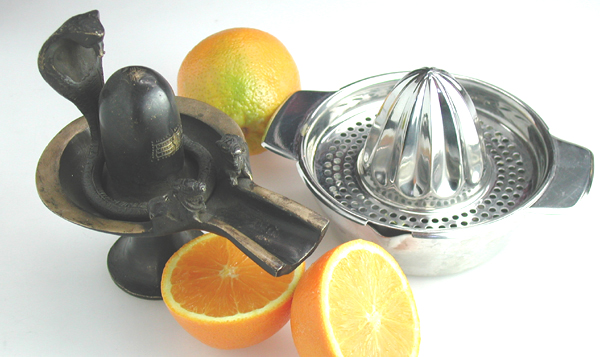
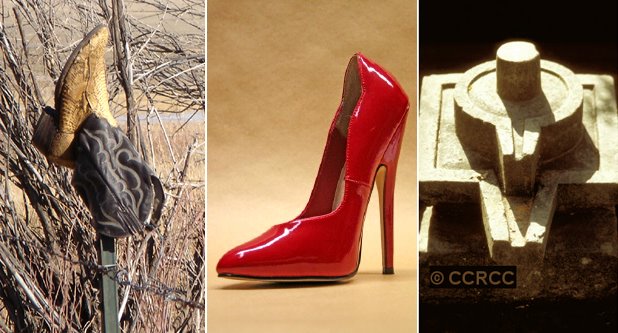
So, top photo, yet another visual simile for your consideration - India's ancient sacred "Post/Vessel" Yonilingam with androgynous serpent, left, and on the right, a Supermarket version? For an explaination of this coital iconograph of Shiva's phallus and Pavarti's vulva, see Yonilingam basics with other reference images here.

Here, a recently discovered commercial iteration  in the middle bars of our visual harmonic- to demonstrate that, indeed, popular culture continually extrudes the mythic!

Other visual affinities within this project: The Bucranium (Sacred Ox Head) and the Crucifix below, and the even more frightening Madonna Code.

18 November 2006

"Sacred vessels" ATOP Posts, Page 12


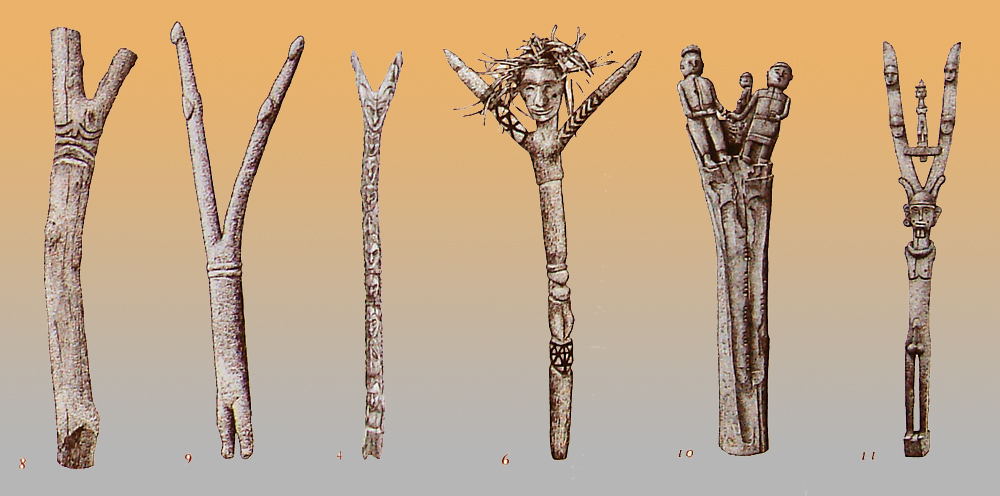
From Carl Schuster, 1996 - left to right: "Y-posts" from Hawaiian Islands; Mangarena; New Guinea; New Hebrides; Borneo; and Sumatra.

My thanks to Ami Ronnberg, Curator of the New York C.G. Jung Center's Archive for Research in Archetypal Symbolism (ARAS) who two weeks ago introduced me to Carl Schuster's twelve volume, 3500 page, 7000 illustration, Social Symbolism in Ancient & Tribal Art produced by Edmund Carpenter and generously "deposited. . .in 600 academic libraries" including the collections at ARAS. Fortunately for poor students, I have been able to find in Denver's Public (read: Plebeian) Library, Carpenter's abbreviated version of Schuster's huge efforts Patterns That Connect, 1996, Abrams, isbn 0810963264. Though Carl Schuster accepted research grants from Jung's Bollingen Foundation, Schuster's prolific "literary executor" (and defender?), Edmund Carpenter, considers Carl Jung as a lightweight "popularizer" (ibid. pg 8) responsible for "past foolishness" and spouting "jungian nonsense" (see bio by Carpenter and bio by Chicago's Field Museum.) But again, thank you, Ami!

While this novice observer sees the "Y-post" (illustration above) as a coital construct with vulvic "V" atop phallic post - the same as our prosaic wine glass - Carl Schuster equates the Y-post as (ibid. pg 14)- "the image of a tree with the branching of the human race. This correspondence between Tree & Genealogy lies beneath a wide range of cultures, in fact, Culture. Ultimately it rests on the analogy of plant propagation and the notion of human birth from budding."

"By its branching, the Tree symbolizes the Tribe, and thereby especially its ancestors to whom sacrifice must be brought. To me, the forked post is the symbolic reduction of the Tree (its use in connection with sacrifice, though important, merely extends its basic meaning as Tree)."

"This association of Tree & Genealogy dates from a least Upper Paleolithic times. What began, I assume, as a 'natural' metaphor, became- quickly, perhaps - an elaborate symbolic system that included limb-sharing ancestors, two-headed, joint-marked figures; and much more. There is nothing 'natural' about these systems: they are inventions, transmitted by word & practice." from Schuster / Carpenter's Patterns That Connect, 1996, Abrams, isbn 0810963264.

In his defense of Schuster, Carpenter points out that (paraphasing) "nothing about Carl Schuster's work evoked greater skepticism than his approach" which "excluded no relevant category of traditional culture," nor "data from diverse cultures, periods and continents". While their book, Patterns That Connect, does extend the Y-post motif to patterns on clothing, to "rebirth" gaming boards and ancient labyrinths, nowhere does Schuster's vast collections include obviously related (and I suppose, even less defensible) "everyday" Y-post motifs such as the Maypole, crucifix, wineglass or our cowboy boots atop posts. Perhaps the larger 3500 page version "deposited in academic libraries" includes the populist mundane - we will see on our next visit to academialand.

06 November 2006

Who is Asher'ah? Part Three: The Weavings


From Book of 2 Kings 23.7, NRSV, 3rd Ed., 2001 "[King Josiah] broke down the houses of the temple prostitues that were in the House of the Lord, where the women did weaving for Asherah." From the Jewish Publication Society's TANAKH, 1999, a transliteration of the Hebrew masoretic text "where the women wove coverings [Hb. batim] for Asherah." Raphael Patai, 1990, page 299 comments "The Septuagint [the early Hebrew Scripture translation to Greek, 300-100BC] [uses the Greek word]'stolas', that is, 'garments' for batim which may be based on an original badim, ie, 'linens'. The expression badim '(a person) clothed in linens' appears as a standing epithet for a mystical figure in Ezekiel 9 and Daniel 12." -from The Hebrew Goddess, isbn 0814322719

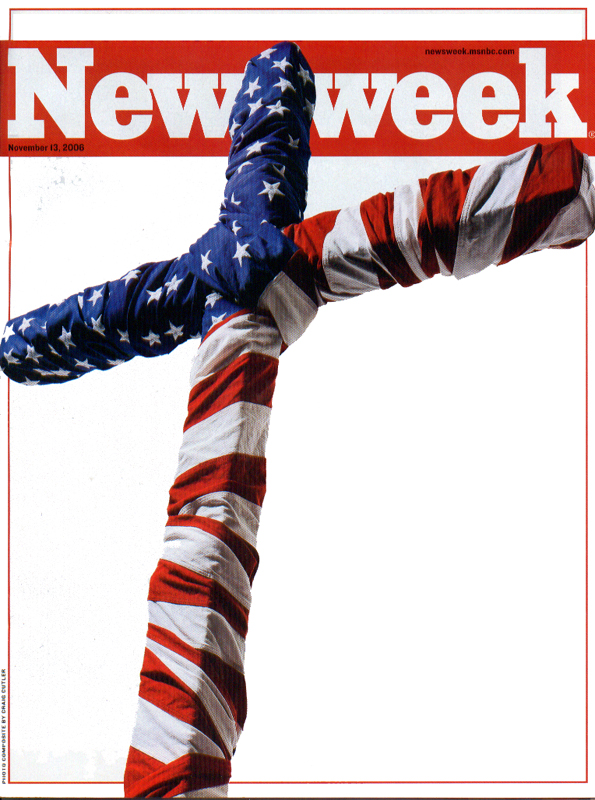
Recall that the general Deuteronomist's usage of an "Asherah" is a "sacred wooden post or pole", not the Goddess. Then the reference to women weaving linens within the precincts of Solomon's Temple for the sacred pole. Sounds a bit like Betsy Ross to me. So, is today's cover illustration of the American edition of "Newsweek", the weekly news magazine, a modern iteration of an ancient ritual? - the symbolic fabric wrapped around the symbolic pole - the ersatz female wrapped around the ersatz male - the image is too perfect. Keep it in mind for future blogs here. Please re-read the two earlier blogs - "Who is Asher'ah?" Part One in June 06 and Part Two in July 06. Newsweek cover illustration credit: photographer,Craig Cutler, 2006.

American voters, please do so tomorrow - for the world's sake.

22 October 2006

"Sacred vessels" ATOP Posts, Page 11


From Leonard Shlain, 1999- "The starched shirt collar with a tie hanging down between its two pointed tabs-an abstract representation of male genitalia-has long been a symbol of patriarchal dominance."

OK, a business mans' necktie as phallus - a fairly "straight forward" idea. I agree initially with Dr. Shlain, author of "Art and Physics", isbn 0688123058, and more importantly, "The Alphabet Versus the Goddess - Word vs Image", isbn: 0140196013, quote above from page 426.

However, take a second look at the dangling phallus from between the two pointed tabs - what we CANNOT see hidden behind the white starched shirt collar is the yonic "loop" around the neck - if we could see the loop, then the necktie closely resembles our coital (or androgynous) "ankh", our "vessel atop a post". Or taken as a whole - "starched shirt collar WITH a tie" - our modern version of the priestly "alb and stole" - we definitely have our "ankh". Then, if we were to add Norman O. Brown's comments from Love's Body,1966, that the "head is phallus", then our neck-tie wearing corporate raiders above began to resemble three side-by-side ancient "phi" "power-on" symbols. (Don't yet "see" this - review earlier "posts" with boots.)

What then does the woman's purse signify? Sidewalk sex workers seem always (USA) accessorized with stilettos heels (vessel w/post) and purse (signifying?) - sacred to mundane - why?

Am looking for the photo credit of the corporate raiders pictured above from the New York Times - one moment please.

14 October 2006

"Sacred vessels" ATOP Posts, Page Ten


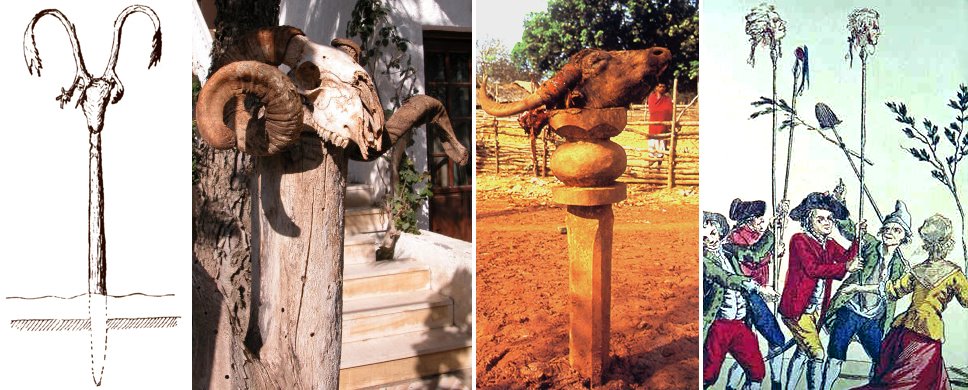
Female reindeer head [c. 12,000 bce], first from left above: from S. Giedion -"Rites associated with the [interment of the] skull [Ed: 30,000 to 10,000 bce - Mousterian to Magdalenian periods]. . .need to be distinguished from rites involving sacred poles or posts, sometime, but not always, surmounted by an animal's head. Such post were made of wood or of stone and became, in some sense, centers of power.

"From the bird on a pole in the cavern of Lascaux, which is being clutched at by a bird-headed man, the tradition of the bird-crowned staff or pole extends until the time of the Lombards in sixth-century Italy and until quite recently anong some primitive peoples [Ed: and well beyond! - to the scepters of modern royalty - ie, doves - and USA/other flag poles - ie, eagles, double eagles].

"An example [drawing, left above] from the northern Magdalenian period (around 8000 bce) was discovered by Alfred Rust in a pond (now meadowland) from the end of the last glaciation at Ahrensburg-Stellmoor, not far from Hamburg. He found there an undisturbed wooden post (2.12 m) still topped with the skull of an aged female reindeer (Ur-Schweiz (Basel), XII, 1948, pp. 68-71).

"Survivals of the cult of the sacred pole persisited until recent years among the Ainus in northern Japan, where the shaman continued to play an important role. Posts with animal skulls, called inao, sometimes clustered almost like a hedge, crossroads--in short, in all places associated with divine beings" (Murdock, 1952, pp. 187-88). Murdock considered that 'that inao are neither gods nor offerings.'

"The final development of the sacred post appears in Egypt, in the obelisk, whose peak was thought to be the resting place of the sun-god Ra. [Ed: ie, golden orb; as, tops of most American flag poles]

"The cult of the sacred post makes it even clearer that both the cult of the skull AND the ritualistic animal intermints [in caves] were closely related to the procreation of the [human] species."

citation above: page 291, S. Giedion, The Beginnings of Art, Bollingen Series, Pantheon, 1962.

Sheep head on post [c. 2002 ce], second from left:
From: Dimitri Subject: [scribblings of unknowing]
Date: Fri, 25 Aug 2006 17:07:35 -0600

Dear Sir,

As an individual who has traveled far and wide, what does it say to you that such Boots Atop Posts seem to be prevalent in the US of A only? In the country where I live, we have beer cans atop posts, Cola bottles on posts, and sheep skulls atop posts? Is there - in your opinion - a difference in the symbology of the whole concept - depending on using a boot or a skull - or does it all signify the same?

Greetings, Dimitri [source of photo, second from left above]

the good Frater answers...

All signifies the same, but as to sheep skulls vs Cola bottles? have you photos of sheep's heads? Compare Freud's Boots with Gimbutas' Skulls - was denken du?

Bulls' Heads on Post [c. 1995 ce], India, third from left above: from Vidya Dehejia, DEVI - "A sacrificial pole erected for a buffalo sacrifice in a Maliah Kondh village. After the sacrifice the Maliah Kondh place the buffalo head on top of the pole like a trophy. India, state of Orissa, Phulbani district, Balliguda area, spring 1995." Note: "like a trophy"; compare with earlier "trophy" posts.

citation above: Vidya Dehejia, DEVI The Great Goddess, Smithsonian Institution, Prestel Verlag, Munich 1999

"heads on pikes", right above - Cartoon or poster of the French Revolution [c. 1789–1799 ce]: "Aristocratic Heads on Pikes"

Cowboot boots, sheep heads, tires, Coke bottles and other "skulls" placed atop posts; national flags, golden orbs and Christs'/Adonis' hung on poles and trees - all the same symbol? What is being symbolized?

08 October 2006

"Christianity, a second-class superstition"?

Quoting from today's New York Times, 08 October, 2006-

"Society 'treats Christianity like a second-class superstition,' Tom DeLay, then a Republican representative from Texas, told the crowd. 'Seen from that perspective, of course there is a war on religion.'" -from the first of a four part series in the Times entitled "IN GOD'S NAME - Favors for the Faithful" which examines "how American religious organizations benefit from an increasingly accommodating government."

"Second-class superstition"? (Hmmm?, a "first-class superstition" would be?) Mr. DeLay, you honor your Christians by several "classes" up from reality. Mr. DeLay should take five minutes out of his busy schedule, find a history book and learn about Adonis, Attis, Osiris - their virgin births and deaths on/as trees and nearly 32 other "super hero" stories that came BEFORE DeLay's annointed Christ mythos. But aside from his concerns about a "second-class superstition"-

by reading and living his own Book, Mr. DeLay could improve the situation of Christian believers and the "war" against them. Without mentioning the obvious for Mr. DeLay - "thou shalt not steal" or "thou shalt not bear false witness" - here is my esoteric choice of six passages from the Christians' Bible which Christians should probably take a second look or, truth told, a first look.

1) for the door knockers, the helpers of the Almighty - Romans 1.19-20: "For what can be known about God is plain to them, because God has shown it to them. Ever since the creation of the world, His eternal power and divine nature, invisible though they are, have been understood and seen through the things He has made. So they (we, the ungodly) are without excuse." Again, for emphasis- Who shows we, the godless, about God? not our fellow worm bait - but it was, for your short moment, so reassuring to be the happy little helper of the great Eternal One.

2) for the Lord's Day folk and Blue Laws - again, Romans - 14.5: "Some judge one day to be better than another, while others judge all days to be alike. Let all be fully convinced in their own minds." Oh, and, by the way, no judging of each others' judgements - entire chapter, Romans 14 - takes all the fun out it.

3) two creation stories- the one you know Genesis 1.1-2.3 and one you do not know, Genesis 2.4-24. Compare. OK, you know the mysogynic rib part, but compare the rest - days of week, etc. - dont forget the Lilith story.

4) two (three) sets of "Ten" Commandments- the one you know, Exodus 20.2-17, with condensed version, Deut.5.6-21 and then the second set you do not know, after Moses broke up the first set, Exodus 34.1-27. Compare all three. Note on Ex. 34: firstborn humans are to be "redeemed" just the same as the first "womb openers" from sheep and cows - "Father, where is my brother?"  Some scholars refer to this second writing as the "Ritual Decalogue. Wiki discussion here.

5) from an earlier post on the "Ten" or however many Commandments that the right winging USA so-called "christians" want posted in every courthouse and government building (who exactly are the Taliban?!) - The Hebrew prophet Jeremiah (Jer. 31.31ff, cf: Heb. 8.6-13) stated that "the days will come that (the Lord) will make a NEW COVENANT, not according to the covenant...made with their Fathers...out of Egypt [that would the be TEN stone ones], but a covenant (He) will...write in their hearts." Well, this has not happened yet - in 2900 years.

This echoed by the apostle Paul (2 Corinthians 3.6,2 NRSV) that "God has made us competent to be ministers of a NEW COVENANT - written not with ink, but with the Spirit of the living God, not on tables of stone, but on tablets of human hearts - for the letter kills, but the Spirit gives life." Still, no action yet - 1960 years later - folks are still "stone" bound.

6) my great favorite - "God with Breasts" - El Shaddai - I promised some esoterica - “By the Almighty [El Shaddai] who will bless you with blessings of heaven above, blessings of the deep that lies beneath, blessings of the breasts [shadayim] and of the womb [racham] ” -Genesis. 49:25, see also Genesis 28:3; 35:11.

(re-edit 08/10)

07 October 2006

"Sacred vessels" BENEATH/ATOP Posts, Page 9


From Joseph Winthuis, 1928- pg. 12 "To the primitive, all straight lines signify the membrum virile - the phallus; whatever is circular or sickle-shaped is the membrum muliebre- the vagina. However unlikely this statement may appear, it is our only way of gaining insight into primitive thought."

This aint pretty - it's becoming an ancient/modern möbius strip of 0's and 1's - this rabbit hole will stay "under construction" - please come back for continuing details of the "boot atop post" icons above and in the previous post.

credit above: Joseph Winthuis, "Das Zweigeschlechterwesen bei den Zentralaustraliern und anderen Volkern" Hirschfeld, Leipzig, 1928 - " a fieldwork in Central Australia; an attempt to prove that the theory of the dual sex being is the main spring of life & expression of physical relationship between male & female; sex relationship & its significance expressed in art; objects (sacred & secular); sagas, cults, songs and ceremonies."

(How polite! - how nice the language of our Australian and German cousins. But in light of the Colorado "cowboy boot on the upright G-d d-mn f-cking fence posts" - no quaint "primitive thought" BS need apply! These f-cking so-called "primitive" symbols extrude today - everywhere - 1011101010101011100!! - did we also mention the popularity of the Base "10" system?)

Regarding the petroglyphs "i", "j", "k" and "l" above - following from their intermediate source (page 234), in S. Giedion's Eternal Present, the Beginnings of Art, 1962, page 230 : "It is astonishing that the innumerable ideograms of eastern Spanish art - those last notes of prehistory from the iron and bronze ages - are still deprived of any precise interpretation, as are also those similar northern symbols, related to them in type and time, from [Clonfinlough,] Ireland [previous post] and the high western Alps. But the expression of male and female qualities has been definitely brought out in a number of different figurations. What, for instance, is the meaning of the strongly definely circular form crossed by a vertical line which comes so close to the form of the Greek letter phi? Is it really only an abstract human figure? Can it not just as well be an androgynous symbol (read: "coitial" here, ye boots/posts folks]? Other signs point to the possibility of this as the highest fertility symbol: generator of life, with life endowed." citation: S. Giedion, Eternal Present, Pantheon Books, Random House, NYC, 1962

Whatever you do, pay no attention to anything like the 1/0 symbol named the "exclaimation" "point", i.e., "!" [we are only the messenger] or its new bigger brother- the so-called, wait-for-it, "Power On" symbol!!! - where to draw the "line" or, is it, inscribe the "oval"? - as you recall, this blog is an attempt to examine symbol where it leads - sacred archetypal (deep 30,000 year old ancient) to the mundane "everyday" (as in even "today's" edit - 10/10 - oh my!).

16 September 2006

"Sacred vessels" BENEATH/ATOP Posts, Page 8


This post has proven to be a bottomless rabbit hole - turning our post/boot over one last time - your patience please. In our last post, from Wikipaedia- "The Globus Cruciger (Latin) is an orb (globus) topped with a cross (cruciger), a Christian symbol of authority used throughout the Middle Ages on coins, iconography and royal regalia. It symbolises Christ's (the cross) dominion over the world (the orb), literally held in the dominion of an earthly ruler (or sometimes celestial being such as an angel)." And from the Encyclopædia Britannica, 2006, entry "orb"- "Christians adapted the [Roman orb] by setting a cross above the ball to signify the world dominated by Christianity. Rulers were often depicted with the orb, but the first to hold it in hand at his coronation was the Holy Roman emperor Henry II in 1014; thereafter the “imperial apple” became an important emblem of the royal power invested in the monarch." Italic emphasis mine.

Once again, "history is written by the victors" and powerful ancient archetypal symbols are brazenly stolen (No. VIII: "Thou shalt not steal". Yea, right!) pirated for profit and manipulation by the present ruling religions. The Globus Cruciger no more "belong" to "Christians" than does the famous bleeding man hung on a tree - that post "soon coming". As an example of such unthinking "divine" attribution of "Christian" symbols, did you hear the one about the Christian honeymoon couple who checks into the motel happily assuming that no other humans have ever before "used" "their" sanctified Christian Bed. Perhaps the Christian toilet? We digress!

Quickly, the ages of the "Christian" "Globus Crucigers" above top, followed by depth references below - A: Cyprus, a young 500 BC (Before Christ); B: Egypt, 2500 BC; C: Spain, 3000 BC; D, E: Italy, 3000-2500 BC; F: Ireland, 3000-2500 BC.

A: From Symbols.com "This is our planet's ideogram, the sign for the earth, or the planet called Tellus. It has been found on a Cyprian coin from around 500 B.C. It is similar to the so-called orb, used by rulers during the Middle Ages to symbolize their control over a part of the earth's surface." From the Encyclopædia Britannica, 2006, "Tellus, also called TERRA MATER, ancient Roman earth goddess. Probably of great antiquity, she was concerned with the productivity of the earth and was later identified with the mother-goddess Cybele. Her temple on the Esquiline Hill dated from about 268 BC. Though she had no special priest, she was honoured in the Fordicidia and Sementivae festivals, both of which centred on fertility and good crops."

B: Three "nefer" - see previous post - drawing of the three "nefers" from the neck of a "nefer" shaped vase, tomb of Kha, Deir el-Medina, 18th Dynasty (1550-1307 bce), page 78, "Reading Egyptian Art" by Richard Wilkinson, 1992, Thames & Hudson, isbn 0500277516

C: From Symbols.com, entry "41b:22" - "A sign engraved in a rock face in Galicia in northern Spain about 3000 B.C." More on this petroglyph and "J", "K", "L" (next post) of the so-called Spanish Art Groups, II and III, in the books: "Prehistory", M.C. Burkitt, 1925, Cambridge Press; "Rock Paintings of Southern Andalusia" by M.C. Burkitt and H. Breuil, 1929, Oxford Press; "Eternal Present" by S. Giedion, 1962, Pantheon Books.

D: "An ideogram engraved in neolithic times in a rock wall in Val Camonica near Brescia in Italy." from Symbol.com. The Valley Camonica has unnumbered tens of thousands of petroglyphs from 5000 bce down to medieval times - see rupestre.net

E: "This ideogram was found carved into a rock wall in Galicia in northern Spain. It was engraved about 5,000 years ago." from Symbol.com - see notes following "C".

F: Clonfinlough, Ireland: Neolithic rock engravings. Drawing after Burkitt from page 234,"Eternal Present" by S. Giedion, 1962, Pantheon Books. This glyph seems to be tied to a large number of mythic ideas from the runic "split year god" to the Christogram of Constantine.  It features in the works of Hermann Felix Wirth ""Die Heilige Urschrift der Menschheit" by Herman Wirth, 1936, Leipzig. The Nazi SS leader Himmler sponsored Wirth at this point of his studies (1935-38).  Locals recall that Abbe Breuil deciphered (c. 1929) the image and concluded that it represented a fight to a finish between the Old Irish and the Milesians in pre-Christian times, 1300BC. The cross-men were charging at the loop-men who in return were retreating from the attack.

26 August 2006

"Sacred vessels" BENEATH Posts, Page 7


Now we enclose the bell/stupa shape to "move" on to the onion-domed Eastern Rite churches, the Roman/Medieval spear/scepter and orb, and the handy all-in-one Globus Cruciger (our upside down "boot atop post") of Queen and Christ.

from left to right, top: 24-domed Intercession Church on the Vytegra River, built 1708 and burnt to the ground in 1963. Colour photograph by Sergei Mikhailovich Prokudin-Gorskii, 1911; Antoniniano of Marcus Aurelius Carinus (Roman Emperor, 283 – July, 285 ad) holding pilum and globe; Albrecht Dürer, "Emperor Charlemagne", 1511/1513, Germanisches Nationalmuseum, Nürnberg, Germany; Unknown, "The Coronation of Elizabeth I", 1558, National Portrait Gallery, London, a copy attrib. to Nicholas Hilliard of the lost original

left to right, bottom: Queen Elizabeth II holds the Globus Cruciger, the "Sovereign's Orb", for her coronation portrait in 1953 © Cecil Beaton / Camera Press; Andrea Previtali , "Salvator Mundi", 1480 - 1528, National Gallery, London; Pedro Berruguete, "Salvator Mundi", 1501, Palencia; Anonymous, "The Virgin Hodigitria", 1677, Museum of Architecture, Kiev

Barbara Walker, 1983, page 188: "The cross [is]..a male symbol of the phallic Tree of Life. .often appeared in conjunction with the female-genital circle or oval, to signify the sacred marriage. The male cross and female orb composed the Egyptian 'Nefer' amulet of blessedness, a charm of sexual harmony [c. 2400 bce]; page 534: It is still customary for rulers to hold the "phallic" scepter in the right [male] hand [and] the "yonic" orb in the [female] left hand. This usage descends from the king's [/Queen's] symbolic display of the 'hieros gamos' [sacred marriage] between himself [/herself?] and the Goddess. The original meaning was that the ruler united male and female principles; but the meaning was lost, and only the symbols remain."

citation: Barbara G. Walker, "The Woman's Encyclopaedia of Myths and Secrets", HarperCollins, 1983, isbn 006250925X

from Wikipaedia- "The Globus Cruciger (Latin) is an orb (globus) topped with a cross (cruciger), a Christian symbol of authority used throughout the Middle Ages on coins, iconography and royal regalia. It symbolises Christ's (the cross) dominion over the world (the orb), literally held in the dominion of an earthly ruler (or sometimes celestial being such as an angel)."

25 August 2006

Dear Sister - Mark Twain's Thoughts

Dear Sister,

Mark Twain holds that one woman requires 35 to fifty men to assist her satisfaction - here is that exerpt - his daughter - may she obtain her reward! - refused to allow publication of "Letters from Earth" until fifty years after Twain's death - here the last half of Letter Eight - Samuel speaks:

"It is as I have said: every statute in the Bible and in the law-books is an attempt to defeat a law of God -- in other words an unalterable and indestructible law of nature. These people's God has shown them by a million acts that he respects none of the Bible's statutes. He breaks every one of the himself, adultery and all.

"The law of God, as quite plainly expressed in woman's construction is this: There shall be no limit put upon your intercourse with the other sex sexually, at any time of life.

"The law of God, as quite plainly expressed in man's construction is this: During your entire life you shall be under inflexible limits and restrictions, sexually.

"During twenty-three days in every month (in absence of pregnancy) from the time a woman is seven years old till she dies of old age, she is ready for action, and competent. As competent as the candlestick is to receive the candle. Competent every day, competent every night. Also she wants that candle -- yearns for it, longs for it, hankers after it, as commanded by the law of God in her heart.

"But man is only briefly competent; and only then in the moderate measure applicable to the word in his sex's case. He is competent from the age of sixteen or seventeen thence-forward for thirty-five years. After fifty his performance is of poor quality, the intervals between are wide, and its satisfactions of no great value to either party; whereas his great-grandmother is as good as new. There is nothing the matter with her plant. Her candlestick is as firm as ever, whereas his candle is increasingly softened and weakened by the weather of age, as the years go by, until at last it can no longer stand, and is mournfully laid to rest in the hope of a blessed resurrection which is never to come.

"By the woman's make, her plant has to be out of service three days in the month, and during a part of her pregnancy. These are times of discomfort, often of suffering. For fair and just compensation she has the high privilege of unlimited adultery all the other days of her life.

"That is the law of God, as revealed in her make. What becomes of this high privilege? Does she live in free enjoyment of it? No. Nowhere in the whole world. She is robbed of it everywhere. Who does this? Man. Man's statutes -- if the Bible is the Word of God.

"Now there you have a sample of man's "reasoning powers," as he calls them. He observes certain facts. For instance, that in all his life he never sees the day that he can satisfy one woman; also, that no woman ever sees the day that she can't overwork, and defeat, and put out of commission any ten masculine plants that can be put to bed to her.[**] He puts those strikingly suggestive and luminous facts together, and from them draws this astonishing conclusion: The Creator intended the woman to be restricted to one man.

"So he concretes that singular conclusion into law, for good and all.

"And he does it without consulting the woman, although she has a thousand times more at stake in the matter than he has. His procreative competency is limited to an average of a hundred exercises per year for fifty years, hers is good for three thousand a year for that whole time -- and as many years longer as she may live. Thus his life interest in the matter is five thousand refreshments, while hers is a hundred and fifty thousand; yet instead of fairly and honorably leaving the making of the law to the person who has an overwhelming interest at stake in it, this immeasurable hog, who has nothing at stake in it worth considering, makes it himself!

"You have heretofore found out, by my teachings, that man is a fool; you are now aware that woman is a damned fool.

"Now if you or any other really intelligent person were arranging the fairness and justices between man and woman, you would give the man one-fiftieth interest in one woman, and the woman a harem. Now wouldn't you? Necessarily. I give you my word, this creature with the decrepit candle has arranged it exactly the other way. Solomon, who was one of the Deity's favorites, had a copulation cabinet composed of seven hundred wives and three hundred concubines. To save his life he could not have kept two of these young creatures satisfactorily refreshed, even if he had had fifteen experts to help him. Necessarily almost the entire thousand had to go hungry years and years on a stretch. Conceive of a man hardhearted enough to look daily upon all that suffering and not be moved to mitigate it. He even wantonly added a sharp pang to that pathetic misery; for he kept within those women's sight, always, stalwart watchmen whose splendid masculine forms made the poor lassies' mouths water but who hadn't anything to solace a candlestick with, these gentry being eunuchs. A eunuch is a person whose candle has been put out. By art.[**]

"From time to time, as I go along, I will take up a Biblical statute and show you that it always violates a law of God, and then is imported into the lawbooks of the nations, where it continues its violations. But those things will keep; there is no hurry."

END of Letter Eight- Letters from the Earth: Uncensored Writings, Harper Perennial Modern Classics, isbn: 0060518650

[I had told my sister that my panic and obsession was - even if we get 125 years here - that we cannot live long enough to set aside the religious baggage acquired by the age of ten. To which she replied, "Eight".]

Your unfaithful brother, Grayholme

More Boots ATOP Posts


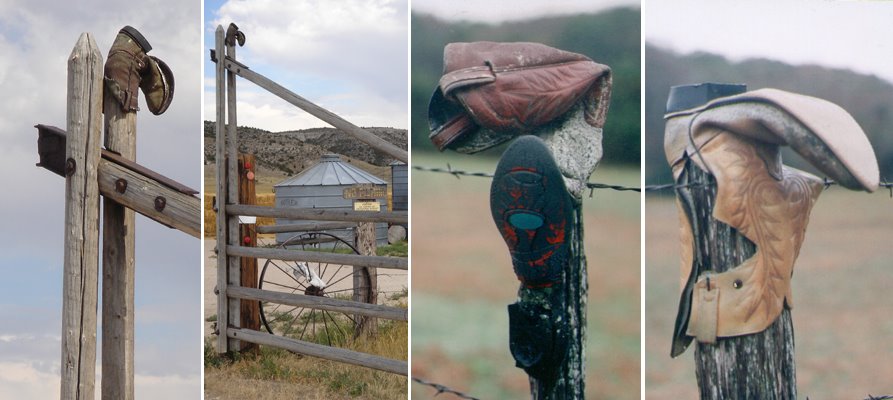
Left above: Back from a two week holiday in Dick Cheney's State of Wyoming with two more cowboy boots atop gateposts (double entendre!) found south of the town of Douglas, the "Jackalope" (antlered bunnys) Capital of the World. The "jackalope" is the American cousin of the "raurackl", the German stag-hare. Certainly, we could begin to add to this blog other "coital oxymorons" - already "gatepost", "cowboy"; consider "belltower", "penrose" or the ancient intended boy/girl word construct - "rosicrucian".

Then right above: photos of two boots on a fence outside of Kerrville, Texas received from Ted Parker of Mason, Texas. If you too have driven by these extemporaneous coital sculptures, please submit any of your photos of "boots atop posts" or related subjects to my email address fraterholme@comcast.net and they will be "posted" here.

Photo below: "Shoe Gate" in New Orleans, January 26, 2001


Now, to review -as blogging is "newest first, oldest last" format - a reminder to take a look first of the older entries - the present thread (perhaps, thin) of this blog is "coital motifs" woven in and out of the sacred and the mundane. To wit - from June 13th's post:

a] "trophy cup" - more or less equal parts male and female "attributes", ie "shoe-atop-post"; "the Holy Grail"; "bell/ghanta";

b] "holly wreath" - the vulvic circle made up of phallic parts, ie "crown of thorns"; "ring of keys", "stone circles";

c] "flowered rod" - the phallic wrapped with various female "attributes", probably our anathemic "asher'ah" object.

d] "axis mundi" - more a virtual male "pole" around which dynamically turns the "feminine" aspect, ie a female earth turning on a male axis as - the ziggurat or "Tower of Babel" winding up vertically to the heavens.

The next three entries will conclude the "trophy" motif and we must let our "boots atop posts" ride off into the sunset.

30 July 2006

Does God need Housing? Beth-El


above, l-r: crystal quartz, natural Asherim, verdant springs, grantite pillars - at our 3800 meter elevation in the Colorado Rocky Mountains, it is too easy to question why other human beings continue to believe that God needs affordable Housing - more Temples, Churches, Qubbas - (more male womb/room envies??). But for the curious, Beth-El (House of "God") of Jacob/Israel fame, may not be exactly what you thought--

from Genesis 28, v.18 "So Jacob rose early in the morning, and he took the stone that he had put under his head and set it up for a pillar and poured oil on the top of it. 19 He called that place Beth-El: 22 And this stone, which I have set up for a pillar, shall be God's house." Note to Gen 28.18 in the New Oxford Annotated RSV, 3rd Ed. 2001; states "Ancient Israelite local sanctuaries featured sacred pillars, perhaps signifying male powers of fertility (see v. 22; 31.13, 45-54; 35.14, 20)." [Ed: "perhaps"?!]

Who is "El"? From Encyclopædia Britannica, 2001- El (Semitic: "God"), the chief deity of the West Semites. In the ancient texts from Ras Shamra (ancient Ugarit) in Syria, El (El the Bull) was described as the titular head of the pantheon, husband of Asherah, and father of all the other gods (except for Baal). Although a venerable deity, he was not active in the myths, which primarily concerned his daughters and sons. He was usually visually portrayed as an old man with a long beard and, often, two wings. He was the equivalent of the Hurrian god Kumarbi and the Greek god Cronus. Writers of the [Hebrew Scriptures] used the word El both as a general term for "deity" and as a synonym for Yahweh.
© 1994-2001 Encyclopædia Britannica, Inc.

27 July 2006

Answering Dimitris - Why Phallos, no Vulva?

Dear Dimitris-

Last July, you asked me, "How come you've suddenly shifted from vulva to phallus?" And two weeks ago, you asked "I can't help but note that you've taken a much greater interest lately (as far as I get to see things) in the Linga and his various manifestations in and from around the world ... whereas I've met you - originally - you were much more a "yoni man". Or was I deceived into thinking so by my own One-Pointed Attention? Seriously. There seems to be shift there. I'd like to know if my perception is right or wrong - or gray."

Dimitris, let me suggest four answers. This serves as a useful cathartic exercise and your recent question comes at an expected moment - I have reached the classic 55 year old point of the householder who can now answer such questions "without care". One point of correction, I have indeed moved, but only from Yoni to Yoni w/Penis and THEIR manifestations - I have yet not moved quite so far as the "Linga and His various manifestations" - nor do I expect to - see Answer 3 below.

ANSWER 1] SPECTACLE! In response to your invitation to write an "short" essay regarding veneration of the Vulva for Demetra's book, one must immediately ask "why does anyone need explaination to venerate the Yoni/vulva which is everyone's arrival terminal?" then, restated "what blocks/blinds everyone from seeing the obvious?" And when we slowly scratch our way back through time to humankind's first images - why, indeed, it was the Vulva (see S. Giedion's Eternal Present, Vol 1, pg 173ff as an example).

[Now to answer your questions, it is useful to be living in the United States at the time of George W. Bush - same question "what prohibits everyone from seeing the obvious?"]

Why?? SPIN vs SILENCE The yX male (in his confused attempts against the obvious yoni double X chroma superiority) SPINS huge spectacle and false promise- sufficent to satisfy his fears some of the time, maybe most of the time. Women in general quietly dismiss men's spectacle out of hand, but say nothing very loudly (not always from any fear, as women have all the actual power and wisdom, but) because the one thing that having actual power and wisdom does (non-attachment) is begat SILENCE, or if not silence, at least not Spectacle. This, as example, is why it is impossible to write an essay on Yoni veneration without revealing one's maleness and male limits - only a man would use words to create a devotional to a bleeding baby hole.

Next, Woman may very likely also be silent regarding the male spectacle because women reasonably lack any first hand knowledge or appreciation of the two principal entangled fears and envies of the yX male from whence "arise" the motivation for his Spectacle and attempts at compensation-

a) envy of woman's blood magic (moon, menses, making babies)- hence male motifs, myth and mentality requiring blood "sacrifice" including war - a part of a male immortality construct. No woman I have met can believe Menses are a point of male envy, but history and the present male blood letting prove otherwise.

b) phallic magic or lack thereof (aka re-erection, resurrection, "who is controlling whom" and/or, more precisely, "is this erection, my very last erection?") A woman, might have a headache, but she is still physically always able to engage in sex and more importantly, to continue her arousal and have repeated orgasms. Men can neither quickly re-engage nor readily have multiple orgasms. (On this point, see Mark Twain's Letters from Earth, Letter 8.)

The "blood envy" construct, I have begun to understand and have been attempting for some time to discuss in my essay, however the latter - "limited phallic magic", I am only now "wrestling" with (55 years old!) - which would no doubt gave "rise" to your observation of my appearance of phallic fixation.


ANSWER 2] THE TEACHER Remember the ancient saying?? "When the student is ready, the Teacher will appear."?? Perhaps true. The discovery that the first icon was the Vulva and that every present day religion, if you but scratch off about 3000 years of history, was controlled by women, not by men - was, for me - shattering. Yes, a "yoni man"! But at the moment, I am coming, Teacher, upon the motif named "phallos wrapped". Certainly my wanderings since my fortunate trip to Patmos have turned up keyhole after keyhole, motif after motif - each which has expanded into a universe after universe of both knowledge and has revealed earlier misinformation. Perhaps this "rabbit holes" of a Path is itself the expected Teacher? (You have certainly been the Bodhisattva to me - calling from the far shore.) But I carry heavy right-wing fundamentalist baggage, acquired before the age of ten (my sister says "before eight years old") which I cannot exhaust in the remainder of this natural life. You, Dimitris, I think, do not have such baggage - that is, your lightness is your advantage. As I identify each item of baggage, I must ask "what is it?", "where did it come aboard?", "where did/does it fit in the mix?, why should I mend it or toss it?" - BEFORE I can move on. This is an exercise of the FISH attempting to unlearn/describe WATER. A short list of the larger pieces of misguided fundamentalist baggage would be:

One Way - Univocation (ie, My Way or the Highway)
Servants of God (ie, the Almighty needs Your help)
Chosen People (ie, you are the OTHER, so I now I can kill you)
Holy Writ "People of the Book" (ie, Holy Words save you for all Eternity, words are NOT proscibed "images" Ex. 20.4ff)
No history, nor human culture (ie, we be leav'ng fo' heaven any day now!)
Linear time and progressive knowing (ie, Christians know more about God than Jews, Protestants more than Catholics, and I know more than you)
God gives Money to the Holy Ones (ie, the poor are sinners)
AND MORE - stay tune in this space - but said much better than I - Chris Floyd's recent article.

ANSWER 3] ÉGALITÉ! The very very few women who have be kind enough to wade into my tirade - "Cantos Cunnus" - have commented that woman give men/phallos much more credit than do I. And that a truely oppressive Matriachy/Yoni could never exist (except among the leather ladies of your homeland), because if men were to relax their Patriarchy / Phallos, things would only come up to EQUAL - ie, women are not so stupid as to create the opposite of a Patriarchy. This is an opinion expressed by the authors in a number of books by women as well as Leonard Schlain' several tomes. This being the case, one could only move from Yoni to Yoni Around Phallos as a move towards balance - "Penis only" would be a step too far.

ANSWER 4] NO LOCAL YONI You may be correct that I have edged towards the Phallos even if wrapped in virtual vulva - but this past year or more your Yoni acolyte has not had the stablising influence of a willing point of devotion. Again, when the Teacher appears and when She disappears - this too is the Path.

Amen, Amen!

Who is Asher'ah? Part Two: The Object


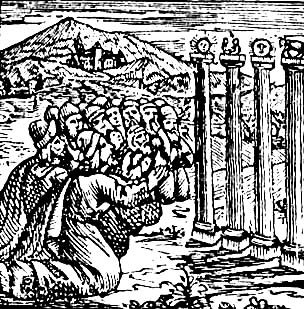
Fanciful woodcut above shows Hebrews worshipping the Sun, Moon and stars atop four aniconic Asherim. This blog will sooner or later get to a more probable iteration.

Citation compiled from Encyclopædia Britannica-

The word Asherah (Ashera, Asherim [plural]) in the [Hebrew Scripture] was used not only in reference to the goddess herself but also to indicate a wooden cult object associated with her worship. Prior to the conquest of Canaan (Palestine) by the Israelites in the 12th-11th century BC, the high places (Hebrew BAMAH, OR BAMA, Israelite or Canaanite open-air shrine usually erected on an elevated site) served as shrines of the Canaanite fertility deities, the Baals (Lords) and the Asherot (Semitic goddesses). In addition to an altar, matztzevot (stone pillars representing the presence of the divine) and asherim (upright wooden poles symbolizing the female deities) often were erected on the high places, which sometimes were located under a tree or grove of trees.

Because the Israelites had associated the divine presence with elevated places (e.g., Mount Sinai), they used Canaanite high places to worship their own God, Yahweh. Canaanite agricultural fertility rites and practices were adopted by the previously nomadic Israelites, often in a syncretic fashion with Yahweh replacing Baal. A strong reaction to the adoption of such rites led to protests by Israelite judges and prophets from the 12th to the late 7th century BC, when the Deuteronomic Reform of 621 bce led to the extirpation of the many local high places which included stone pillars, wooden Asherim and altars as sites of worship.
© 1994-2001 Encyclopædia Britannica, Inc.

from Edward Carpenter, 1914: As to the Asherah, or sometimes plural Asherim, translated "grove,"--for which the women wove hangings--the most generally accepted opinion is that it was a wooden post or tree stripped of its branches and planted in the ground beside an altar, whether of Jehovah or other gods. Several biblical passages, like Jeremiah ii. 27, suggest that it was an emblem of Baal or of the male organ, and others (e.g., Judges ii. 13, and iii. 7) connect it with Ashtoreth, the female partner of Baal; while the weaving of hangings or garments for the "grove" suggests the combination of female with male in one effigy. At any rate we may conclude pretty safely that the thing or things had a strongly sexual signification.

Intermediate Types among Primitive Folk by Edward Carpenter, pg 34 [1914] LONDON GEORGE ALLEN & Co. LTD

And BEST article in the internet on Asher'ah and Her connections is Asphodel Long's "Asherah, the Tree of Life and the Menorah : Continuity of a Goddess symbol in Judaism?" presented in 1996 at the College of St. Mark & St. John, Plymouth, UK [w/ excellent bibliography!) I would only add to Ms. Long's connections the Priestly redactor's concerns re: Aaron's blooming Rod and other "power" staffs which populate the Hebrew Scripture.

Two excellent books on this question are:
Patai, Raphael The Hebrew Goddess. Wayne Univ. Press Detroit 1990 isbn: 0814322719
Hadley, J. M. The Cult of Asherah in Ancient Israel and Judah- Evidence for a Hebrew Goddess. Cambridge Univ. Press 1997 isbn: 0521662354

29 June 2006

"Sacred Vessels" BENEATH Posts, Page Six


Above, l-r: Buddhist hand-bell; Schoolmarm's Bell c. 1930; bottle of Courvoisier; Capital Building, Denver, Colorado; Bodnath Stupa, Kathmandu

Now we turn our rancher's boot atop the fence post on its head, tip the wine glass upside down-

From Robert Beer, 1999 “The ritual hand-bell or vajra ghanta (Tib. rdo rje drilbu) ... [incorporate] the two main ritual [Buddhist] implements that symbolise the perfections of method or skilful means (vajra), and wisdom or emptiness (ghanta). As a sexual symbol, the hollow 'lotus' of the bell represents emptiness as the vagina, and the prongs of the vajra - symbolising the four nadi which emanate from the 'jewel-wheel chakra' at the tip of the male sexual organ- represent form or appearance. When paired [ed: separated], the vajra is held in the right hand, and the bell in the left, representing the inseparable union of method and wisdom. Their union is the coincidence of great bliss and compassion as pure emptiness and form.”

citation: Robert Beer, The Encyclopedia of Tibetan Symbols and Motifs, Shambhala (1999) ISBN: 157062416X, page 243

Symbolism for the stupa

18 June 2006

"Sacred Vessels" ATOP Posts, Page Five


From Linda O'Keeffe, 1996 "In 16th-century Venice, shoes called chopines (right above) placed women's feet on platforms that frequently rose to unprecedented heights of 30 inches or more. Venetian husbands reputedly introduced the heavy wooden chopines to prevent their wives from straying.

"Manchu women (left above, late 19th century) with unbound feet wore shoes on pedestals to imitate the mincing "Lotus foot" step admired by Chinese men. The stilt-like bases were made from sewn layers of starched cotton."

Citations: Words and photos from "Shoes - A Celebration of Pumps, Sandals, Slippers & More" by Linda O'Keeffe, Workman Publishing, New York 1996

"Sacred Vessels" ATOP Posts, Page Four


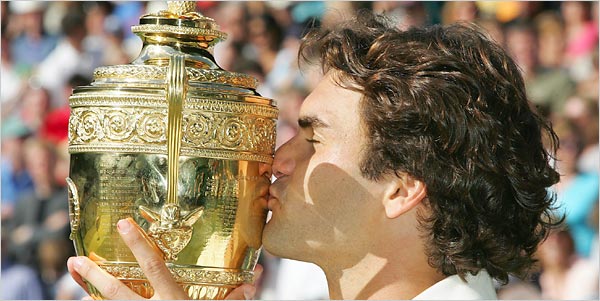
Above: "Roger Federer became the third player in the Open era to capture four successive Wimbledon tennis championships" -NYTimes.com, July 11, photo: Gerry Penny/European Pressphoto Agency

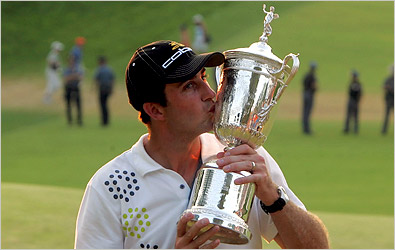
Below: Geoff Ogilvy kisses his "Loving Cup" trophy, US Open, June 18th, photo: Barton Silverman/NY Times

From Silver Gallery- "Loving Cup Trophy acquired its name from the English. In hopes of enhancing the chances of good crops or health, it was customary to sip spiced beverages from a bowl passed from person to person. Each would kiss the vessel which came to be known as the Loving Cup."

(In case, you thought I was making this stuff up.)

16 June 2006

Evening Koans


The flowered tree is not well hidden.
That shorn, stands between.

Avoid their noisy markings.
Our Paraclete, quiet Chaos.

14 June 2006

Speak! O! Sphinx!


It would be well if the males' compensations - for their lack of connection with Nature; for any obvious continuation beyond death (as women have through birth giving); and for fear of life itself - would simply stop with his invented symbols, written language, wars and religions - BUT he does not stop there - instead he immediately HIDES, whatever his latest invented compensation, inside a somewhat literal inversion of the “Pandora’s Box” mythos.

That is, the male hides that latest paradigm – enclosing all his evil inside the Box - and then he EXCLUDES Pandora and her sisters from seeing what new inventions are inside His SPECIAL box. If we apply the logic - "if smoke, then fire" – that is, if the evidence is first observed that there is now a blatant exclusion of women from the latest male construct, then we may conclude that there is a new paradigm defining one of man’s latest false compensations against death and his fear of living.

As possible examples-
If no female teachers; then education and alphanumeric systems are a false male compensation.
If no female priests; then religions, abstract belief systems are. . . .
If no female doctors; then study of medicine and life sciences are. . .
If no female vote; then government, borders, land boundaries are. .
If no female lawyers; then law systems, corporations, last wills and testaments
If no female soldiers; then wars and implements of war,
If no female inquisitors; then sin, guilt, evil, Devils
If no female competitors; then team sports, races, race cars
If no actresses (kabuki, Shakespeare, Greek); then theater, politics
If no female brotherhoods; then secret societies, fraternities
If no female name givers (nominclators); then naming names, patronyms (male surnames), sacred divine names (“in the Name of the Father, Son and Holy Ghost”); honorifics, titles, magic incantations– (cf: Egypt: Hekau below.)

In all, one aweful Tool Box of futile and failed wonders.

Interestingly, one learns with little study that most or all of these constructs mentioned above are not even male inventions, but rather direct robberies from Pandora- as example, from RC Camphausen: “incantations or magic words = the Egyptian “hekau” (from Hekat - Egyptian toad-headed goddess of birth) comes from the Thracian Goddess Hecate (“older than Zeus and Osiris”) who is the archetypal high goddess of magic (her name means “Extending Her Will from Afar”). In this sense then, perhaps “Words of Power” (hekau/magic) do not necessarily/always have to be male-made.”

13 June 2006

More "Sacred Vessels" high ATOP Posts


There appear to be four coital motifs which meander in and out of popular and sacred culture - this oversimplification is somewhat new ground, so we are inventing language/names which will no doubt change as we blog along-

a] "trophy" - more or less equal parts male and female "attributes" which we see above, ie "shoe-in-post"; "Holy Grail"; "bell/ghanta",;

b] "holly wreath" - the vulvic circle made up of phallic parts, ie "crown of thorns"; "ring of keys"

c] "flowered rod" - the phallic wrapped with various female "attributes", probably our anathemic "asher'ah" object.

d] "axis mundi" - more a virtual "pole" around which dynamically turns the "feminine" aspect, ie female earth turning on its male axis or the ziggurat or "Tower of Babel" winding up vertically to the heavens

This post begins the first category- "trophy", then follow through the other three motifs.

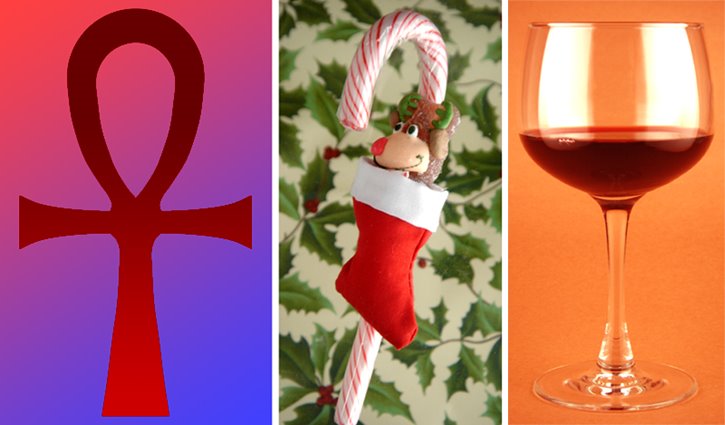
From ARAS Online: "The ankh or crux ansata - the sign of life - has the form of a looped knotted cross. As a syllable, this hieroglyph is the root of no less than twenty four words. Of these, Brugsch (cited by Giedion) lists fourteen which retain the original sense of the root: to have existence, to renew existence, to will into existence. Other meanings include those of 'eye' and 'ear' which divert in meaning to that of opening. Winthius (cited by Giedion) observes that the picture of an opening or an eye is recognized by some ethnologists as a picture of the vulva."

"Giedion believes that the Egyptian sign of life may be related to the prehistoric fertility symbols of vulva and phallus, the upper part corresponding to the Aurignacian symbol for the vulva, combined with an abstraction of the phallus, yielding in combination a symbol of androgyny, of the eternal renewal of procreation, of the magic power inherent in the union of male and female."

"In early Christian times, the ankh was modified by Egyptian Christians into the Coptic cross."

credit: ARAS Online [online archive] Record No. 2Ac.008, New York: The Archive for Research in Archetypal Symbolism; available from www.aras.org; accessed 15 June 2006.

Citations mentioned by ARAS:
The Eternal Present: The Beginnings Of Art.
S.Giedion, Pantheon Books. Bollingen Series XXXX\V 6.1, 1962. pp.120,231,233.

The Eternal Present: The Beginnings of Architecture
Giedion, S. Pantheon Books, 1964., pp.89-93.

More about the related popular images of Christmas stocking /candy cane and wine glass - or do you already see where we are headed??

Who is Asher'ah? Part One: The Goddess


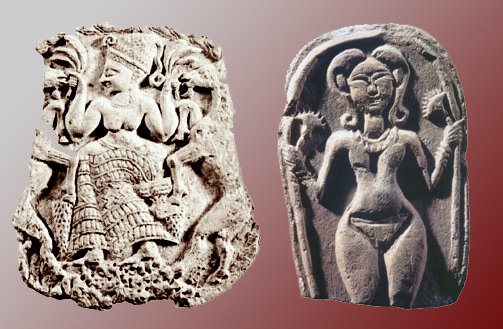
Photos above: left, Asher'ah, detail from an ivory box from Minat al-Bayda' near Ras Shamra, Syria, c. 1300bce; in the Louvre, Paris; right, Astarte, with Lotus blossum, Canaan, 3000-2000bce; Israel Museum(IDAM), Jerusalem - see John Singer Sargent's wonderful Astarte in Boston Library.

Against who did the Yahwist prophets of the Hebrew Scriptures rail (Judges 6.25-32; 1 Kings 16.32,33, Ezekiel 8.1-18)? And what was her wooden aniconic image which they repeatedly "broke, cut, hewed, burned and uprooted" (2 Kings 23; 2 Chron 31.1,34.4,7)? First, the goddess - Part Two: The Object.

Drawing from the several citations in the hopefully "neutral" Encyclopædia Britannica , here is what we can easily learn of Asherah (aka- Astarte of Phoenicia, Ishtar of Akkadia, Inanna of Sumeria, Aphrodite of Cyprus, Hathor/Isis of Eygpt, cf: Tara of present day Tibet ). (Why say "neutral"? - a] remember that history, as well as religions and law were written by yesterday's victors and that b] today's fundamentalist believers "of the Book[s]" still avoid any competitive mythos - then, it is best, if possible, to find neutral playing fields.)

From the EB: Asher'ah (or Ashtoreth) was an ancient West Semitic goddess and consort of the supreme god, El (cf: Beth-El). Her full name was probably "She Who Walks in the Sea," but she was also called "Holiness," and, occasionally, Elath, "the Goddess." According to the texts discovered at Ugarit (modern Ras Shamra, Syria) in 1929, by a French archaeological mission under the direction of Claude F.A. Schaeffer, Asher'ah was the mother of 70 gods by her consort, El. She is also called simply Qudshu, "Holiness." Asherah is associated with the sea and with serpents. As mother goddess she was widely worshiped throughout Syria and Palestine, although she was frequently paired with Baal, who often took the place of El in practical cult; as Baal's consort, Asherah was usually given the name Baalat.

Many Ugaritic texts reveal an older Canaanite mythology. A tablet names the Ugaritic pantheon with Babylonian equivalents; El, Asherah of the Sea, and Baal were the main deities. These texts not only constitute a literature of high standing and great originality but also have an important bearing on Old Testament studies. It is now evident that the patriarchal stories in the Old Testament were not merely transmitted orally but were based on written documents of Canaanite origin, the discovery of which at Ugarit has led to a new appraisal of the Old Testament.

According to the Hebrew Bible, Asherah and Astarte were both worshiped in Israel during the first half of the 1st millennium bce, and Hebrew inscriptions attest to a pairing of Yahweh and Asherah. Up to the time of King Josiah's reform (621 BC) there was a women's cult of Asherah (under qedeshim auspices [consecrated for fertility practices], according to 2 Kings 23:7) in the Jerusalem [ed: aka Solomon's] Temple. The qedsha was one of a class of sacred prostitutes found throughout the ancient Middle East, especially in the worship of the fertility goddess Astarte (Ashtoreth). These prostitutes, who often played an important part in official temple worship, could be either male or female. Although Israelite prophets and reformers repeatedly denounced sacred prostitution, the early Israelites seem to have adopted the local Canaanite rites, which they apparently practiced publicly until the reform of King Josiah about 622 BC.

Asherah's Hebrew devotees considered her the chief wife of Yahweh, even as she was the wife of El, head of the Canaanite pantheon, for in the Bible El is identified with Yahweh. But Josiah eliminated the cult of Asherah, and official Judaism has since then left no place for other gods, which meant the elimination of every goddess. Popular religion, to be sure, persisted in the female fertility principle until the destruction of the Temple in 586 BC. In Judaean excavations Astarte figurines were found in private homes down to that time. Further purification of the Hebrew religion, which was intensified by the catastrophe of 586, put an end to the practice of pagan fertility rites, including the use of goddess figurines. Without goddesses there could be no sexual activity in the pantheon, and thus Judaism has developed without a divine mother figure.

Copyright © 1994-2001 Encyclopædia Britannica, Inc.

09 June 2006

Bush's "Marriage Amendment"

Mr. Bush, the good Christian leader of the free world is at it again this week, to get out the vote this fall among his Christian "core". For the second time, he uses the word "marriage" with the word "gay" - as such oxymorons brings out the lexic folks en masse. For us, dyslexics, "civil union" are the right words. Both sides should put down the word "marriage", especially Christians who rarely read their Book and have no idea of what their founding "father" has been said to have said about "marriage"- for your interest:

First, Christianity was to have been a high speed, short term, SINGLE generational (Matt. 24.15-21, 34) escape strategy from the tainted planet Earth for the “chosen” people - no marriage assembly required - we would be "as the angels" (Matt. 22.30). The shackles of family and earthly concerns were to be thrown down (Matt. 10.34-37, 1 John 1.15-17). St. Paul suggested celibacy (1 Cor. 7.1-7). Jesus recommended much, much worse (Matthew 19.11,12)- "Not all men can receive this precept, but. . .there are eunuchs, who have made themselves eunuchs, for the sake of the kingdom of heaven. He who is able to receive this, let him receive it." Ouch! John the Revelator allowed that the 144,000 saints who surround Christ “the Lamb” on the heavenly Mount Sion “were not defiled with women” (Revelation 14.4). Defiled by women?

"Christian marriage" is the oyxmoron.

04 June 2006

Why are the boots on fence posts? Answer:


We are considering symbols winding in and out of the sacred and mundane. What motivates the rancher to place boots on fence posts? Do you see any similarity between the boots atop the posts and two images that follow? - the shoe-WITH-a-post stiletto and the yonilingam - Shiva's "post" and Pavarti's "shoe"?

Perhaps some background is helpful - Freud suggests that the shoe is the symbol of female genitalia ("Symbolism in Dreams", in Complete Psychological Works of Sigmund Freud, Tr. and Ed. James Strachey, Hogarth Press, London 1963, vol.XV, p.158 ). And that the foot is a penis substitute (Freud, "Symbolism in Dreams", in op.cit., pp.155-6). So, does the rancher, consciously or unconsciously, create a coital symbol - vagina atop penis - down miles of country lanes?

But to my growing right-wing Protestant "family", physicians that went on to become psychiatrists were Anathema, little better than the Devil Incarnate. Very well.  Let's turn to 3000 year old Holy Writ - where the feet, legs and thighs are also used as equivalent phallic "euphemisms" to avoid mentioning the extra frightening name of the male reproductive organ itself (just as the Hebrews avoided the name of their monodeity) - as example - after Moses received his divine commission at the Burning Bush to go before the Pharaoh seeking the release the Hebrews, the same all-knowing "Lord" tries to kill Moses because he turns out to be uncircumcised (Ex. 4.24ff). But his quick thinking wife, Zipporah, cuts off the foreskin of her son and touches Mose's "feet" with the bloody foreskin, saying "Truly you are a bridegroom of blood by circumcision to me!" So the Lord spares Moses' life. Commentary says (NRSV 3rd ed), "'Feet', a euphemism for the genitals (see Isa 7.20)". (Never heard this story, I'll bet.)

OK, Isaiah 7.20 reads "On that day the Lord will shave. . .the head and the hair of the feet, and will take off the beard as well" refering to shaming of prisoners. Shave the "hair of the feet"? Or Jacob (Israel) tells son, Joseph, to make an oath by putting "your hand under my thigh and promise to deal loyally and truly with me" (Genesis 47.29). Similar "euphemisms" are used in Greek myths of a birth-giving male Gods, such as Kumarbi begats the the West Wind from his "thigh" or Zeus who gives birth to Dionysus from his "thigh" / aka penis.

The words, "testament" and "testify" come from the same root meaning as "testicle" - that is, one made an oath by placing your hand over something more precious than your mother's grave! From the knee (penis??) or "genu" comes "genuflect" - to bend the knee in worship. YHWH's covenant with Abraham, father of the Hebrews and Arabs, needed something more than a flexible penis, it required an oath signed with the blood of circumcision (Gen. 17.9-14) - 99 year old Abraham, his 13 year old son, Ishmael and all his male slaves were so "covenanted" on the same day. (Menstrual envy is here suspected by some scholars.)

So, if foot = penis, then boot = vagina. Atop a country fence post?

Still not convinced? Freud and Holy Writ not enough? On the back cover of Barbara Walker's book "The Woman's Encyclopedia of Myths and Secrets" isbn 006250925x, she asks "Why was Cinderella's glass slipper so important to the Prince?" Her answer, pg 168- "Beautified with her new riches, Cinderella won the Prince . . . Their union was symbolized by fitting her foot into a shoe, a common sexual allegory." Need more? From Robert Graves, "Greek Myths: 1" paper isbn 0140010262, pg 94 "Demeter's ecstatic initiates [celebrating the Eleusinian ('advent') Mysteries - 1500bce to 396ad] symbolically consummated Demeter's love afair with Zeus in an inner recess of the shrine by working a phallic object up and down a woman's top-boot;" this being "the temple of she who rages in a lurking place." Yet more? Charles Panati's Extraordinary Origins of Everyday Things, Harper 1987, isbn 0060960930, pgs 26,27 "Today old shoes are tied to newlyweds' car and no one asks why. Originally, shoes were only one of many objects tossed at a bride to wish her a bounty of children. In fact, shoes were prefered over the equally traditional rice and wheat because from ancient times the foot was a powerfully phallic symbol [Ed: Panati fails to state the obvious converse - that the shoe was therefore a powerful vulvic symbol]. In several cultures, particularly among the Eskimos, a woman experiencing difficulty in conceiving was instructed to carry a piece of an old shoe with her at all times."

Does a fence post within a boot then equals "hard core xxx" farmer symbolism? Makes certain fetishes easier to understand. More comments to come on other "sacred vessels" high atop (or beneath) poles in this obsession to discover the proletariat's "Asher'ah".

LinkWithin

Related Posts Plugin for WordPress, Blogger...