Who is she
that looks forth like the dawn, fair as the moon, bright as the sun,
terrible as an army with banners? Song of Solomon 6.10
"And
a great portent appeared in heaven, a woman clothed with the sun,
with the moon under her feet, and on her head a crown of twelve
stars; she was with child and she cried out in her pangs of birth, in
anguish for delivery. (Revelation 12:1,2) . . .She brought forth a
male child, . . . but the child was caught up to God and his throne."
(Revelation 12: 5) . . .the woman was given the wings of the great
eagle that she might fly . . . into the wilderness." (Revelation
12:14)
21
December 1995
Alkmini
Karavis
SPIRIT OF BYZANTIUM
Agias Lesvias Square
85500
Hora, Patmos GREECE
Dear Ms.
Karavis,
Perhaps
you remember me during the 1900th Anniversary Celebration of the
writing of the Apokalypsis (the last book of the Christian "New
Testament", also called "The Revelation of St. John")
this past September - an American with a tall Greek friend from
Athens [really, from Volos]. We returned several times during the
week, but did not find you again. You mentioned that you would accept
a commission to create an icon. Please accept the following request
and the enclosed payment of 85,000 drachmas. I will leave the quality
and size of the icon to your judgment.
 |
| Icon by Alkmini Karavis |
I
realize, in my brief study of eastern orthodox iconography, that the
believer holds that the first icons "are made without hands"
and that the iconographer only replicates that original image without
attaching any of his or her own personality. Thus, I hope that to
commission an icon [and, I suppose, your accepting a commission] is
not too much a secular idea that would offend the devote
iconographer. I wish to illustrate the image of the Woman of
Revelation 12. I believe it is she who connects us with the sacred
images of the feminine from prehistory with those many images and
apparitions [some 21,000+] since John's vision on Patmos. I have
quoted parts of the English text of the Apokalypsis [from the Revised
Standard Version] and will make specific graphic requests with
personal comments. I have attached copies of other such art as might
assist the artist as a starting point.
Comments
regarding the image of the icon and its parts -
a] the
woman should be shown descending from the heavens so her "clothes
of the sun" would appear weightless and floating. The "sun"
light surrounds her transparently with her features nearly, or
completely, covered in "light". Perhaps the aurora
borealis, or similar, surrounds her head.
b] the
moon should be shown at crescent, not the full moon as some attached
images show. This is my graphic preference (and consistent to the new
moon of Artemis, Inanna and other prehistoric images.)
c] The
crown of twelve stars should be literally "twelve stars".
Some writers and artists have made "twelve stars" into
images of the twelve signs of the zodiac, or the twelve apostles or
the twelve patriarchs. Perhaps the stars are small shooting stars
more like the arrows of huntress Artemis (see below). (I particularly
like the attached ER Hughes' painting, "Night with her Train of
Stars" where the ". . .Stars" are children.)
d] The
woman should be shown very pregnant, in the midst of her "anguish
for delivery", the child about to be born, with one hand over
and the other hand under her belly- very reasonably, she is probably
not exactly standing "with the moon under her feet".
e]
Some later images show the woman holding the baby as if Madonna and
Christ Child, an idea especially popular in Northern Europe during
the 15th century, apparently part the Mariology that accompanied the
so-called "counter Reformation". (Compare with the the
image of Our Lady of Guadeloupe, Mexico, at a similar time frame of
1531). This is certainly not the image of John's dream - the child is
taken directly to "God and his throne", and the mother
escapes the Dragon to the wilderness where she has even more
offspring (Rev. 12.17) - this mother never holds her child.
 |
| Captions below. Here: 2, 3.1, 3.2 |
f] The
wings of the eagle are not given to the woman until after the birth
of her son to help her escape from the Dragon into the wilderness.
Graphically I prefer the wings to be near by - ready for attachment,
not yet attached. I suggest the four wings as Ezekiel's eagle faced
cherubim [Ezekiel 1] and also note Ezekiel 17's "great eagle
with great wings, long winged, full of feathers, which had divers
colors.." [verse 3]. As the wings are not yet attached, they
might be used as purely graphic elements - in the corners or as
borders, perhaps swirling around the woman - to symbolize the four
corners of the earth or the four winds [Rev. 7:1]. The wings might be
in the four colors of the Four Horsemen of Revelation 6 - white, red,
black and pale - together with gold as if drawn by Klimt.
g]
The wilderness - harsh, mountainous, rough, stony - should be shown
in the lower third of the image. I think the Fortress-Monastery of
St. John, its hills and surrounding would be perfect. [Note: Ms.
Karavis chose the view of the sea from the Cave of the Apokalypsis
that is the traditional writing place of the Book of Revelation.]
h]
Background to image might be dark blue at the top graduating to light
as in an early morning sunrise.
 |
| 4.1, 4.2, 5.1, 5.2 |
Personal
comments and background information, based on as yet, a very
superficial study -
1]
Contrary to my impression (raised as a fundamentalist American
Protestant), the island of Patmos in John's time was not a deserted
isle for Rome's exiles, but a populated mid-point of active
Mediterranean sea trade with at least 4000 inhabitants. Within 20
minutes walk of John's Cave of the Apokalypsis was an important
Temple to Artemis (complete with priestesses?), which was destroyed
in 1088 AD by monks to built the summit site of the present
Fortress-Monastery of St. John.
According
to the inscription in marble in the Monastery's museum, this was
specifically a Scythian or Tauropolos Artemis. Perhaps the chief
Scythian goddess, Tabiti-Hestia, patroness of wild beasts as was
Artemis. A very short distance from island of Patmos was the city of
Ephesus in what is now Turkey, the place of John's death, which was
the center of worship to Artemis [the Roman Diana] (Acts 19.23-40 )
and where, curiously, Mary was declared THEOTOKOS ("Mother of
God" or "God-Bearer") at Pope Celestine I's Council of
Ephesus in 431 AD. (The Temple of Artemis in Ephesus was rediscovered
in 1869.) Artemis was the "goddess of the new moon, of
wilderness, its animals, a huntress and - though herself a virgin
without a children - the patroness of childbirth; - according to
Euripides (Hippolytus, 165-8) "I cried out for Artemis in
heaven, who loves the hunt and whose care relieves those giving
birth". The statue of Artemis in Ephesus shows her with the
multiple breasts to nourish her many "offspring". Artemis
is most often depicted with eagle wings and her wild animals. Our
woman of Revelation 12 is "in her pangs of birth" and her
eagles' wings take her to the wilderness where she has even more
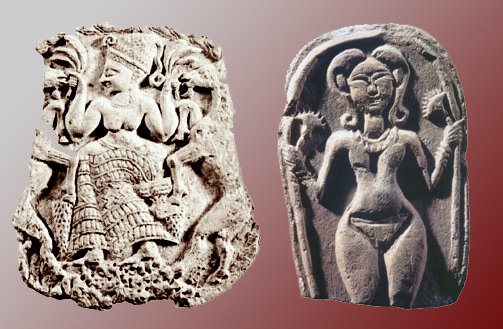
offspring. Also compare with the "Lilith" of the Jewish
Torah and of earlier Sumerian myths, who as Adam's first wife, taking
umbrage to the recumbent position he demanded, uttered the ineffible
Name of God, flew on (Owl's) wings to the wilderness, where she gives
birth to hundreds of demonic offspring daily (see picture).
2]
Patmos is located near to the Cyclades island group. Apparently
Patmos has had very little modern archeology (my friend and I did
climbed the Kastelli hill - finding 2000 year old pottery shards
covering the summit), but it is certainly possible that figurines
similar to the many found in the burial plots of nearby Cyclades
Islands could well be present on Patmos.
3] I
think is would be best that this icon be painted by a woman
iconographer, either native of, or living on, the Island of Patmos.
She should have the broadest understanding of the universality of the
revealed images of divinity or, a better English [and Greek] word,
the "epiphany" - ineffable divinity manifest in an concrete
image - this I think is the reason for creating an icon. Familiarity
with the Symbolist and Pre-Raphaelite movements in the 19th century
might be useful.
With
all this madness, I leave the icon in your good hands. From the poet
Yeats -
Once out
of nature I shall never take
My bodily form from any natural
thing,
But such a form as Grecian goldsmiths make
Of
hammered gold and gold enamelling
To keep a drowsy Emperor
awake;
Or set upon a golden bough to sing
To lords and
ladies of Byzantium
Of what is past, or passing, or to come.
Warm
regards, Gary Regester
 |
| 6.1, 6.2, 7.1, 7.2 |
13
March 1996
Alkmini
Karavis
Spirit of Byzantium
Patmos HELLAS
Thank
you for the fax. Good to learn you have received my packet. I thought
I might not hear from you until summer.
I think
you understand my request very well. There is no hurry. I understand
that ICONS are "not made by human hands". So let your
thoughts grow and take their own path. Since my visit to Patmos and
re-reading the Apocalypse, I see that this woman is a wonderful
bridge described by John on Patmos which connects the spiritual
epiphanies before the coming of Christianity with those epiphanies of
today and of the future. I agree that she is unclothed and surrounded
by the sun or sunlight. And that the image includes the ideas of the
2nd Chakra, the waxing and waning moon, etc. etc. I look forward to
your sketch and explanation. Further to Ezekiel's angels with the
eagle's face and four wings, John also has the same idea in
Revelation 4:7,8 which I overlooked, "and the fourth living
creature like a flying eagle. . . with six wings about him. . .never
ceases to sing, 'Holy, holy, holy is the Lord God Almighty, who was
and is and is to come!" This creature announces the pale
horseman of Death (Rev. 6:7). So two, four or perhaps six eagles
wings around our lady.
Certainly,
the mythology surrounding the divine feminine is a 20,000 to 30,000
year old spiritual epiphany that connects human, animal and plant
existence. All who are women-born well know that "holy Matrix"
during our first years of life. Memories of which are quickly
eclipsed by the newer 4000 year old "us vs them, sky god"
cosmology, accompanied by its necessary warrior cult, that
disconnects us from each other and the earth. Given the resultant and
accelerating destruction of both human life and the earth, the return
to this earlier mythology is deserving of further and more serious
consideration.
Warm
regards,
Gary
Regester (I have added some general background information to the
original letters.)
 |
| 8.1, 8.2, 8.3, 9.1, 9.2 |
Images
by panel and number from left to right - 1. Icon by Ms. Karavis,
1997; 2. Detail in frame, portable icon on the screen of the
katholikon of St. John the Evangelist in the Fortress-Monastery of
St. John on the island of Patmos; 3.1 The Virgin on the Crescent with
a Crown of Stars, Albrecht Duerer, 1508, note the "man in the
moon" detail; 3.2 The Madonna Appears to St. John, by Albrecht
Duerer, 1511; 4.1 Die Jungfrau der Apokalypse, von Flammen umgeben,
Malerei vom Meister des Hausbuches von Wolfegg, second half of the 15
Century, Museum Unterlinden, Colmar; 4.2 Virgin of the Apocalypse,
Workshop of the Master of the Amsterdam Cabinet , Germany, 1480-90,
The Cloisters, Metropolitan Museum of Art, NYC; 5.1 Woman and the Red
Dragon, William Blake, 1805, National Gallery, D.C.; 5.2 The
Glorification of the Virgin, Geertgen tot Sint Jans, ca. 1480, Museum
Boymans-van Beuningen, Rotterdam; 6.1 Madonna, Holz-Plastik, 1675,
Dom, Erfurt, Germany; 6.2 Our Lady of Guadeloupe, Mexico, 1531; 6.2
Venus of Laussel, Dordogne, 20,000 BC, Musee d'Aquitaine, Bordeaux,
France; 7.2 Sumerian "Lilith", ca. 2000 BC, British Museum;
8.1 Female Figure of Late Spedos Type, Early Cycladic II, ca. 2400
BC, JP Getty Museum, Los Angeles; 8.2 Artemis and her lion, c. fifth
century BC, British Museum; 8.3 Die schoene Artemis from the Temple
of Artemis, Ephesus, Selchuk Museum, Turkey; 9.1 Prayer card of the
Miraculous Medal modeled on the visions of Catherine Laboure, 1830,
note the Virgin stands upon a serpent, but it is the earth, not the
moon; 9.2 from the book, Apokalypse of John, by Antones Murodias,
1995, Patmos, Greece; 10. ER Hughes' painting, "Night with her
Train of Stars", 1912, Birmingham City Museum, UK;
 |
10
|
References:
"The
Myth of the Goddess", by Anne Baring and Jules Cashford, Viking
(Penguin) 1991;
"The Civilization of the Goddess", by
Marija Gimbutas, Harper Collins, 1991
"The Language of the
Goddess", by Marija Gimbutas, Harper Collins, 1989
"Alone
of All Her Sex", by Marina Warner, Vintage (Random House)
"Answer to Job", by Carl Jung, Princeton University Press, 20121983