From this morning's "The Fences That Could Set Global Neighbors Off" by Daniel Schorr on National Public Radio and from Louis Untermeyer, ed. (1885–1977). "Modern American Poetry", 1919.
64. Mending Wall by Robert Frost. 1875–1963
SOMETHING there is that doesn't love a wall,
That sends the frozen-ground-swell under it,
And spills the upper boulders in the sun;
And makes gaps even two can pass abreast.
The work of hunters is another thing: 5
I have come after them and made repair
Where they have left not one stone on stone,
But they would have the rabbit out of hiding,
To please the yelping dogs. The gaps I mean,
No one has seen them made or heard them made, 10
But at spring mending-time we find them there.
I let my neighbor know beyond the hill;
And on a day we meet to walk the line
And set the wall between us once again.
We keep the wall between us as we go. 15
To each the boulders that have fallen to each.
And some are loaves and some so nearly balls
We have to use a spell to make them balance:
"Stay where you are until our backs are turned!"
We wear our fingers rough with handling them. 20
Oh, just another kind of outdoor game,
One on a side. It comes to little more:
He is all pine and I am apple-orchard.
My apple trees will never get across
And eat the cones under his pines, I tell him. 25
He only says, "Good fences make good neighbors."
Spring is the mischief in me, and I wonder
If I could put a notion in his head:
"Why do they make good neighbors? Isn't it
Where there are cows? But here there are no cows. 30
Before I built a wall I'd ask to know
What I was walling in or walling out,
And to whom I was like to give offence.
Something there is that doesn't love a wall,
That wants it down!" I could say "Elves" to him, 35
But it's not elves exactly, and I'd rather
He said it for himself. I see him there,
Bringing a stone grasped firmly by the top
In each hand, like an old-stone savage armed.
He moves in darkness as it seems to me, 40
Not of woods only and the shade of trees.
He will not go behind his father's saying,
And he likes having thought of it so well
He says again, "Good fences make good neighbors."
13 May 2007

04 May 2007
01 May 2007
May Pole Diary

Build your own Maypole. Why not? What ancient memories might be elicited upon viewing? And how would a May Pole in the flag waving western United States survive? First attempt, left above, at flying a neutral (non patriotic) tricolor - magenta, cyan, yellow - pole about 300 ft above the village ended in less than 24 hours with a group of 6 men (now known) dissembling the fabrics but politely laying the pole on top of the rock outcrop. Next attempt was to time the next pole construction with a more public local Irish festival (second above), then remove the Irish tricolor to the mountain; its deconstruction occurred about one month later by unknown ax wielding person(s) who removed the fabrics completely and placed the pole nearby on the ground. Pole was "re-clothed" with autumnal hops blossoms and re-erected (fourth, fifth above). De-construction of this version occurred about six weeks later after first snows and a six foot section (2M) was removed from the middle of the pole by a saw wielding (they are learning!) yet unknown person(s). The pole remains were removed for the winter into the village and then redressed in "legal" Christmas wreaths and re-positioned for Mayday / Beltain in photos below - after its first week, it remains, but a pre-emptive immolation is scheduled for proper Beltain fire on the evening of May fifth (Cinco de Mayo) - (Update: before weather permitted its immolation, person(s) unknown removed this fourth iteration on evening of May 20th) - photo of installation next.

From Wikipedia - Beltane
Beltane has a complex etymology and a resultant variety of different spellings.
The word Beltane derives directly from the Old Irish Beltain, which later evolved into the Modern Irish Bealtaine. In Scottish Gaelic it is spelled Bealltainn.[9] Both are from Old Irish Beltene ('bright fire') from belo-te(p)niâ. Beltane was formerly spelled 'Bealtuinn' in Scottish Gaelic; in Manx it is spelt 'Boaltinn' or 'Boaldyn'.
In Modern Irish, Oíche Bealtaine is May Eve, and Lá Bealtaine is May Day. Mí na Bealtaine, or simply Bealtaine is the name of the month of May.
In the word belo-te(p)niâ) the element belo- is cognate with the English word bale (as in 'bale-fire'), the Anglo-Saxon bael, and also the Lithuanian baltas, meaning 'white' or 'shining' and from which the Baltic Sea takes its name.
In Gaelic the terminal vowel -o (from Belo) was dropped, as shown by numerous other transformations from early or Proto-Celtic to Early Irish, thus the Gaulish deity names Belenos ('bright one') and Belisama.
From the same Proto-Celtic roots we get a wide range of other words: the verb beothaich, from Early Celtic belo-thaich ('to kindle, light, revive, or re-animate'); baos, from baelos ('shining'); beòlach ('ashes with hot embers') from beò/belo + luathach, ('shiny-ashes' or 'live-ashes'). Similarly boil/boile ('fiery madness'), through Irish buile and Early Irish baile/boillsg ('gleam'), and bolg-s-cio-, related to Latin fulgeo ('shine'), and English 'effulgent'.
All photos can be enlarged by a click. Note older posts' link - as each newer post builds on these before it, take a look from the beginning. Thank you and please comment.
22 February 2007
Happy New Year - Miaos' Flower Pole

From chinaculture.org- Flower Mountain Festival takes place during the two weeks following New Year's Day each lunar calendar year to pray for happiness of the Miaos and bless with safety and prosperity. During the festival, the Miaos get dressed up and go to the large lawn near the village. They play the Lion Lantern Dance, swing, blow bamboo leaves and play the bamboo flute. People erect in the mountain a "flower pole" dyed in red and blue in 12 segments to pray to the god for giving birth to children. Young men and girls riot in dancing and singing and seek their lovers. The entertainment lasts three days, and the Miao villages are filled with animated dance and songs.
On the very day, the erection of the Flower Pole is to precede the activity of the Flower Mountain Festival. The Flower Pole is the icon of the Flower Mountain. It is also the performance tool in the festival. It is made of straight and decorticated fir in several zhang (1 zhang = 3.3 m) high. Afterwards, people plant it in the middle of the Flower Mountain to form the center of the entertainment -- Lusheng ground. The Lusheng players play the Lusheng and dance under the Flower Pole with the contests of climbing pole when playing Lusheng, and climbing pole when playing Lion Dance. There are also programs such as the antiphonal singing, bullfight, horserace, bird match and various martial arts performances, which make the Miaos immersed in great happiness.
The festival not only provides all villagers with the festal gathering, but also the unmarried young people with the chance to seek their lovers. In the mountains south of Yunnan Province, the homemade telephones are installed to enable young men and girls, without knowing each other, communicate with each other or sing through homemade call before date. There is another interesting way of selecting lovers: the young men wander in the crowd. As he found his favorite girl, he will stealthily draw near to her. When he stands at her side, the young man will open the umbrella to cover the girl and sing to observe her reaction. At this moment, the girl keeps silent and skews at the young man. If she finds the young man unsatisfied, she will still keep quiet or refuse by singing. If she likes the man, the girl will look at the young man and sing a sweet song tenderly. As they feel satisfied with each other, the girl will offer her ring to the young man as the keep sack. When the Flower Mountain Festival ends, the spoony girl will follow her lover.
In the Flower Mountain, the most favorable young men are those fellows who climb the Flower Pole while heading down and taking up the Lusheng and pig head. He has to climb up and down keeping playing Lusheng, which can match with the acrobatics. The crowned young man is not only regarded as the hero, but also the icon among the girls. It is said if the young man courts some girl, she will surely fall in love with him.
NPR.org's Flower Mountain piece by Louisa Lim or listen to the story. Credit on photo above, also Louisa Lim.
16 February 2007
11 February 2007
On a Sun's day morning, dear Teacher-

When you get a chance, I am curious about the narrative of the dream that caused your recent contact. Also, any thoughts on my attempts at unlearning by means of this modern bile smearing bloggering - the "fool" in the "where angels fear to tread" - as Jesus Himself warned - "pray only in your closet" (Matthew 6.6) and stay off the street corners and infohighways.
I will ponder to dying day the proper direction and misdirection allowed to teachers by his/her conscience. I read today in his biography that even Julius Wellhausen had pedagogical misgivings- "Wellhausen received a professorship at Greifswald, [but] resigned in 1882 because he believed that his teachings were having a dire effect on theological students destined for the ministry, and because he had become a figure of controversy over his published views on the Old Testament."
By the late 1960s, not only had Wellhausen's now well developed "Documentary Hypothesis" (P-E-J-D sources) called into question the fundamentalists' understanding of authorship of Hebrew scripture, but Wellhausen's approaches to "biblical history" (1878) had also set off the largely failed attempts at "proving" Hebrew scripture through "biblical archaeology" - showing that any actual reality afforded Scripture before 1000bce was fanciful ethnocentric myth, at best, equal to Homer's stories - no Abram, no Issac, no Moses, no falling Walls of Jericho, no David, no Solomon, no Israel, not even a camel - and of all this, from my religious teachers, not one word.
Add to this, the wider body of huge mythological works produced between 1900 and 1960s- such as Fraser's 12 volume "Golden Bough"(1906-15); Briffault's 1800 page "Mother's"(1927); Graves'"White Goddess"(1948); and the early efforts of Joseph Campbell and Mircea Eliade. Again not one word. Perhaps to the odd high school bible student off to conduct a storefront evangelical series - a headsup might have been in order - a "look out for the truck!" or similar.
As a seven year old child, my father would pay me $10 to read small condensed volumes of a children's encyclopedia. His admonition was to "Skip over the mythologies, because they might cause one not to believe in Bible stories." Being an obedient child and seeing the shorter path to the $10s, I skipped the mythologies.
Now, as my own wandering muse, I am beginning to puzzle over the dynamics of "forbidden knowledge" and its dangers- "when to hold them...when to walk away". Silent knowledge surrounds us, as do severe reprisals for speaking. As a present example of the unspeakable, the last thing any of us in the United States are allowed to even ponder, during the Bushes' αρμαγεδδων, is the earlier question, "What Jewish homeland?" (above).
(And the mundane - even to suggest that wrapping evergreen roping around a bridge railing is an ancient vulvic/phallic exercise - this too is forbidden knowing - and never, ever suggest that a baseball cap, a pickup truck and the SuperBowl are the same compensatory symbols - be prepared for a bloody nose.)
Listen to today's NPR "Children of Abraham"
Further link to "what did the biblical writers know and when did they know it?" which in fairness to the "1960s" comment above, speaks of an ongoing controversy at present.
Image credit: Wm. Blake's Woman Clothed in the Sun
08 February 2007
"One Man's Ceiling, Another Man's Floor"

Photo caption reads: The swastika is a sacred symbol for Hindus, who are protesting its proposed ban in the EU. Here Hindus in India celebrate Diwali by lighting lamps in the shape of a swastika. Photo credit: Reuters
SPIEGEL ONLINE - January 17, 2007, 12:38 PM
URL: http://www.spiegel.de/international/0,1518,460259,00.html
CROSSED SWORDS - Hindus Against Proposed EU Swastika Ban
European Hindus are opposing German calls for an EU-wide ban on swastikas, arguing that the Nazis hijacked the Hindu symbol which actually stands for peace.
Germany's plans to push for a Europe-wide ban on swastikas may seem reasonable enough to those who prefer not to see far-right extremists sporting Nazi symbols in public. Unless of course, you are a Hindu, for whom the Nazi era is just an unpleasant blip in the millennia-old symbol's history.
European Hindu groups have come together to oppose a German proposal to introduce a ban on Nazi symbols -- including the swastika -- within the European Union, arguing that the Nazis hijacked the Hindu symbol.
"The swastika has been around for 5,000 years as a symbol of peace. This is exactly the opposite of how it was used by Hitler," Ramesh Kallidai of the Hindu Forum of Britain told Reuters. The swastika is commonly used as a blessing in Hindu rituals such as weddings.
"It is almost like saying that the Ku Klux Klan used burning crosses to terrorize black men, so therefore let us ban the cross," he added. "How does that sound to you?"
Hindus from the UK, the Netherlands, Belgium, France and Italy want to form a pressure group in the European Parliament in May to oppose the ban. They plan to visit European Commission leaders and members of the European Parliament to put pressure on them to resist the German move.
Germany, which took over the six-month rotating presidency of the EU at the beginning of this year, wants to launch an initiative to make Holocaust denial and the display of Nazi symbols a crime across the whole EU. The swastika and other Nazi symbols are already banned in Germany.
"In Germany the fight against racism and xenophobia is both an historic duty and a current political concern," Germany's Justice Ministry said in a statement earlier this month.
Kallidai said Germany's initiative was probably well-meaning but said that Hindus had not been consulted.
"Every time we see a swastika symbol in a Jewish cemetery, that of course must be condemned. But when the symbol is used in a Hindu wedding, people should learn to respect that," he told Reuters.
"In Sanskrit it means May Goodness Prevail," he said. "Just because Hitler misused the symbol, abused it and used it to propagate a reign of terror and racism and discrimination, it does not mean that its peaceful use should be banned."
Even within Germany, the swastika ban can be problematic. There was an outcry last year when the owner of an anti-fascist mail order company in Stuttgart was fined for selling anti-Nazi merchandise featuring swastikas with a line through it.
dgs/reuters © SPIEGEL ONLINE 2007
02 February 2007
Kissing the Shroud

Photo by Max Becherer, appearing in the New York Times Travel Section, part of an article entitled "The Mysteries of Kabul" published January 21, 2007. This particular image is not part of the excellent NYT's "slide show" of Becherer's Kabul photographs.
Caption for the photo above reads "Shiite Muslims kissing a sacred shroud before prayer." For those following these "scribblings", this single image of the adoration of a wrapped pole is worth more than any 1000 word comment (. . .we are only the messenger!).
"Imbloc" aka "Groundhog Day", February 2

Already half the way from solstice (December 21) to spring equinox (March 21), we reach the "quarter" holiday of "Imbloc" known only to those who do not accept the accepted "Groundhog Day". Why not?? perhaps a clue from the White Goddess site- but compare with Wikipaedia's Groundhog Day-
"Imbloc (Candlemass, Imblog, Imbole) - February 2nd Pronounced: EE-Molc
"This holiday is also known as Candlemas, or Brigid's (pronounced BREED) Day. One of the 4 Celtic "Fire Festivals. Commemorates the changing of the Goddess from the Crone to the Maiden. Celebrates the first signs of Spring. Also called "Imbolc" (the old Celtic name). This is the seasonal change where the first signs of spring and the return of the sun are noted, i.e. the first sprouting of leaves, the sprouting of the Crocus flowers etc. In other words, it is the festival commemorating the successful passing of winter and the beginning of the agricultural year. This Festival also marks the transition point of the threefold Goddess energies from those of Crone to Maiden.
"It is the day that we celebrate the passing of Winter and make way for Spring. It is the day we honour the rebirth of the Sun and we may visualize the baby sun nursing from the Goddess's breast. It is also a day of celebrating the Celtic Goddess Brigid. Brigid is the Goddess of Poetry, Healing, Smithcraft, and Midwifery. If you can make it with your hands, Brigid rules it. She is a triple Goddess, so we honour her in all her aspects. This is a time for communing with her, and tending the lighting of her sacred flame. At this time of year, we will light multiple candles, white for Brigid, for the god usually yellow or red, to remind us of the passing of winter and the entrance into spring, the time of the Sun. This is a good time for initiations, be they into covens or self-initiations.
"Imbolc (February 2) marks the recovery of the Goddess after giving birth to the God. The lengthening periods of light awaken Her. The God is a young, lusty boy, but His power is felt in the longer days. The warmth fertilizes the Earth (the Goddess), and causes seeds to germinate and sprout. And so the earliest beginnings of Spring occur.
"This is a Sabbat of purification after the shut-in life of Winter, through the renewing power of the Sun. It is also a festival of light and of fertility, once marked in Europe with huge blazes, torches and fire in every form. Fire here represents our own illumination and inspiration as much as light and warmth. Imbolc is also known as Feast of Torches, Oimelc, Lupercalia, Feast of Pan, Snowdrop Festival, Feast of the Waxing Light, Brighid's Day, and probably by many other names. Some female Witches follow the old Scandinavian custom of wearing crowns of lit candles, but many more carry tapers during their invocations.
"It is traditional upon Imbolc, at sunset or just after ritual, to light every lamp in the house - if only for a few moments. Or, light candles in each room in honour of the Sun’s rebirth. Alternately, light a kerosene lamp with a red chimney and place this in a prominent part of the home or in a window.
"If snow lies on the ground outside, walk in it for a moment, recalling the warmth of summer. With your projective hand, trace an image of the Sun on the snow.
"Foods appropriate to eat on this day include those from the dairy, since Imbolc marks the festival of calving. Sour cream dishes are fine. Spicy and full-bodied foods in honor of the Sun are equally attuned. Curries and all dishes made with peppers, onions, leeks, shallots, garlic or chives are appropriate. Spiced wines and dishes containing raisins - all foods symbolic of the Sun - are also traditional."
Further Imbloc / Candlemas links:
Wiccan Web Weavers
Candlemas, from a Roman Catholic view
The Light Returns
30 January 2007
Local Pagans, Church Goin' Folk


No one questions a wreathed vertical lamp post or wrapped VERTICAL STOP sign, or a wreath on a picket fence (Ménage à many) and wishful thinking, but wrapping a (horizontal) bridge with evergreen and ribbons? I had never seen this before. Perhaps a hint: In an article about a Neolithic village near Stonehenge in today's New York Times--
"In a teleconference conducted by the National Geographic Society, Dr. Parker Pearson said a circle of ditches and earthen banks at Durrington Walls enclosed concentric rings of huge timber posts — “basically a wooden version of Stonehenge,” he said.
"The excavations exposed not only the timber circle but also a roadway paved with stone leading to the Avon River, about 500 feet away, which was similar to a river road from Stonehenge. The evidence, Dr. Parker Pearson said, “shows us these two monuments were complementary” and that “Stonehenge was just one-half of a larger complex.”
"They said the road was paved with flint and led straight from the Durrington enclosure to the (River) Avon. A similar road at Stonehenge, discovered in the 18th century, is aligned on the midsummer solstice sunrise, the archaeologists noted, while the one at Durrington lines up with the midsummer solstice sunset. Similarly, the Durrington timber circle was aligned with midwinter solstice sunrise, while a giant stone monument at Stonehenge frames the midwinter solstice sunset.
"Venturing into the bumpy field of Stonehenge interpretation, Dr. Parker Pearson suggested that the durable stones of the better-known site were a memorial and final resting place for the dead, and the wood architecture at Durrington Walls symbolized the transience of life. People from all over the region, he said, probably came there to celebrate life and deposit the dead in the river for transport to the afterlife."
Hmmm? a paved flint road leading from a circle of stones to a river? seems like our "post with vessel". Does it equals a bridge from the stone circle to the river of the Afterlife/HereAfter? Do wrapped bridges over a river equal a wrapped (vulvic) Phallus (Bridge) over a rebirthing (vulvic) River? I can only tell you that this Land's mundane folk will (unconsciously) always be streaming wrappings about phalli to their last breath - OK, perhaps too large a cognitive leap - here's a related but even greater reach, good luck! - does no one discern our (USAs) famous "star-spangled banner" with its streaming "broad stripes and bright stars"?--
thank you, Francis Scott Key-
"Oh, say can you see by the dawn's early light
What so proudly we hailed at the twilight's last gleaming?
Whose broad stripes and bright stars through the perilous fight,
O'er the ramparts we watched were so gallantly streaming?
And the rocket's red glare, the bombs bursting in air,
Gave proof through the night that our flag was still there.
Oh, say does that star-spangled banner yet wave
O'er the land of the free and the home of the brave?"
07 January 2007
"Sacred vessels" ATOP Posts, Page 14

In my hurry to change subjects to the "crown of thorns" motif, my transitional wreath/tires atop post page reminded me that I had skipped an important wreath/post category above - the flowery captial atop the column (meaning that we will probably skip the newer Antebellum phallic columns that line the vulvic entrance porches of the Southern United States, but may not skip the more esoteric Boaz and Jachin of Solomon's Temple)-
from our trusty Encyclopædia Britannica - "CAPTIAL, in architecture, the crowning member of a column or other columnar form, providing a structural support for the horizontal member (entablature) or arch above.
"Two kinds of simple stone capital have been found in the stepped-pyramid complex at Saqqārah (c. 2890–c. 2686 BC). One, a saddlelike shape, suggests bent reeds or leaves; the other, an upturned bell, derives from the papyrus plant. Later Egyptian architecture used capitals derived from such plant forms as the palm and lotus,
"Three widely used forms of the capital were created by the Greeks. The Doric capital consists of a square abacus surmounting a round form with an egg-shaped profile called the echinus, below which are several narrow, ridgelike moldings linking the capital with the column. The Ionic capital—probably related to the volute capitals of western Asia—has a tripartite design consisting of a pair of horizontally connected volutes inserted between the abacus and echinus - its echinus is carved with an egg-and-dart motif. The Corinthian capital is basically an abacus supported on an inverted bell surrounded by rows of stylized acanthus leaves.
"Design of capitals in medieval Europe usually stemmed from Roman sources. Cubiform, or cushion, capitals, square on top and rounded at the bottom, served as transitional forms between the angular springing of the arches and the round columns supporting them. Grotesque animals, birds, and other figurative motifs characterize capitals of the Romanesque period. At the beginning of the Gothic period, exotic features tended to disappear in favour of simple stylized foliage, crockets, and geometric moldings, particularly in France and England." from "capital." Encyclopædia Britannica 2006
Notes on motifs used on captials atop columns above - generally, feminine; all - of regeneration and immortality:
reeds - Wilkinson, 1992 - the "emblematic" reeds or "sekhet" is "a symbol of 'that which is produced by the fields'. . .the sekhet is thus sometimes personified as a goddess bearing offerings" such as "ducks, goslings, eggs" and other "'food and provisions' for the god."
papyrus - Posener, 1962 - "the papyrus became the vigorous symbol of the world in gestation;"
palm - Chevalier, 1969 - "palms. . are regarded univerally as symbols of. . . regeneration and immortality". - Walker, 1983 - "the palm branch signified the virility of the god, Osiris, in union with his mother-sister-wife, Isis. . . or Tammuz, united with his mother-bride, Ishtar". Wilkinson, 1992 - "the palm branch was the symbol of the Egyptian god, Heh, the personification of eternity."
lotus - Walker, 1983 - "Before creation, the Hindus said, all the world was golden lotus, 'Matripadma', the Mother Lotus, womb of nature. In Egypt, the great goddess was called the lotus from whom the sun was born at his first rising." Chevalier, 1969 - "the lotus is pre-eminently the archetypal sexual organ or vulva, a pledge of the continuity of birth and rebirth." Wilkinson, 1992 - "as a symbol of rebirth, the lotus was closely associated with the imagery of the [Egyptian] funerary cults."
eggs and darts - Walker, 1983 "its original meaning was an endless line or circle of men (darts) and women (eggs). . .the ancient sexual connotations are even more clearly portrayed in the Egyptian versions which alternated downward-pointing phallic symbols with narrow oval slits each topped by a diamond-shaped 'clitoris'."
inverted bell - we have discussed the vulvic bell in earlier blog.
acanthus leaves - Chevalier, 1969 - "the acanthus motif was used extensively in funerary architecture to designate the trumphant conquest of the trial of life and death, symbolised by the thorns on the leaf of the plant. As with thorns in general, the acanthus is the symbol of . . .virginity - and that too implies another sort of triumph."
References above:
Jean Chevalier et al, Penguin Dictionary of Symbols, 1969 London isbn 0140512543
Barbara Walker, Woman's Dictionary of Symbols and Sacred Objects, 1988, Harper Collins San Francisco isbn 0062509233
Richard Wilkinson, Reading Egyptian Art, 1992, Thames & Hudson London isbn 0500277516
06 January 2007
Storied Monkey Riding Subconscious Tiger

I am more and more puzzled about how deeply we unquestioningly act out the drama within the archetypal, especially, per this blog, within the coital archetypal, while on the face of it, the act of sex, as only one example, in judeo- christian- islamic Abramic Yahweh- Jesus- Allah culture of the present patriarchal, always warring paradigm, is "sehr forbotten". But it is the sex, not a killing war, that is forbidden. Yet no one seems to have a problem hanging the symbolic vulvic wreath on the phallic door; nor a cowboy boot, tire or bottle atop a fence post - but strangely, this is done for no conscious reason whatsoever, just somehow makes "them" feel better. Perhaps, it's the "them" that's the rub. Here's a hint for the New Year from the NY Times - click to the full article:
from Dennis Overbye Free Will: Now You Have It, Now You Don’t New York Times, January 2, 2007
"Having just lived through another New Year’s Eve, many of you have just resolved to be better, wiser, stronger and richer in the coming months and years. After all, we’re free humans, not slaves, robots or animals doomed to repeat the same boring mistakes over and over again. As William James wrote in 1890, the whole “sting and excitement” of life comes from “our sense that in it things are really being decided from one moment to another, and that it is not the dull rattling off of a chain that was forged innumerable ages ago.” Get over it, Dr. James. Go get yourself fitted for a new chain-mail vest. A bevy of experiments in recent years suggest that the conscious mind is like a monkey riding a tiger of subconscious decisions and actions in progress, frantically making up stories about being in control."
04 January 2007
Missing Index for Walker's "Myths"
As a pilgrim intent on peeling back the layers of obfuscation (look it up!), one begins to discover Graves' "White Goddess", Briffault's "Mothers", Camphausen's "Yoni" and Barbara Walker's 1120 page opus, "Women's Encyclopedia of Myths and Secrets" isbn006250925X oft quoted in this blog. Yes, OK sometimes Barbara is "over the top", I know her motivation too, too well - but she, unlike many other writers' over heavy agendas, does in fact well cite her source material - extensively, and page by page - her book's genius. All the more strange then that her 1120 page book fails to offer any index whatsoever. Shame! shame! on the cheap editors of HarperCollins. No index until now- a free PDFd 40+ page index to Walker's amazing work by two amazing altruists, Cheryl Brooks and Beedy Parker -
In Beedy Parker's own words: "A comprehensive (40 page, 6400 entries) index to The Woman's Encyclopedia of Myths and Secrets by Barabara G Walker, is available, by e-mail or as print copy (at cost of copying and postage), from Beedy Parker at beedyparker@gwi.net , (207) 236-8732, or 68 Washington St., Camden, ME, 04843. We view this as an ongoing project, subject to correction if errors are found or more entries should be made.
"The index was produced by Cheryl Brooks, a professional indexer, in 2003, at the instigation of B. Parker who was frustrated by not being able to retrieve many of the fascinating references in the Encyclopedia which do not have their own alphabetic entries. Barbara Walker herself, who was contacted, said that the publisher did not feel that an enormous index, added to an already large book (1124 pages) would make sense. So we undertook to do it ourselves and are now making it available to others.
"Barbara Walker's The Woman's Encyclopedia of Myths and Secrets (HarperCollins, 1983) is an extremely valuable reference, based on the author's wide reading in folklore and mythology. It documents, entry by entry, the fate and historic distortion of matriarchal religion by triumphant patriarchy in the last few thousand years. Reading it, slowly and methodically over the course of several years, was a revelation to me and put into place many of the seemingly senseless customs and rationalizations of creeds and beliefs of our major religions and our folkloric traditions. A recurring theme is the metamorphosis of feminine deities into masculine form, especially within the Christian and Judaic traditions.
"I understand that the WEMS, as we have come to call it, is not entirely respected in all academic circles. Barbara herself sees this as largely patriarchal backlash. It is also based on scholarly doubts about some of her sources (a marvelous bibliography of some 385 books), within the context of a battle for academic high ground in the shifting world of history of religion since the arrival of Women's Studies. Barbara Walker has the advantage and disadvantage of not being an academic, free to read as she pleases and judge for herself, as does the reader, but not held to scholarly proof and peer approval. She also has written on more esoteric subjects, tarot, sacred stones, women's rituals, and is a gifted and well known designer of graphic knitting patterns, all rather suspect to serious students. Her book The Woman's Dictionary of Symbols and Sacred Objects (HarperCollins, 1988) provides an iconic adjunct to the WEMS, and it would appear that her work in researching women's religious history stems from her fascination with pattern and symbol, which are often keys to a hidden and repressed past, seemingly innocent.
"The book was welcomed with accolades in the 80's and has been on course reading lists and many bibliographies. The essays at particular entries are excellent, well written and often stand by themselves as thoughtful critiques of cryptic subjects. I hope that an index will make it even more useful as a reference to information which is not readily available to people, particularly women, who wonder how we got to where we are.
"My purpose in making the index available is actually as an environmentalist, because I see, as does Barbara Walker, our treatment of women, socially and within the great religions, as part and parcel of our destructive treatment of the "environment", as "Other", and disposable, by the dominant mind set. Feminine and Nature are often seen as similar and even the same, now and in the past, whether worshipped or abused. I do not think we can survive our abusive views and behavior. Shaking this domineering foundation at its historic and prehistoric roots could help bring us round to the respect, care and love of the natural world we are a part of, to true awe. I see this reference as a revolutionary resource."
from Beedy Parker, 02 January 2007
Again, the link to Barbara Walker's WEMS Index.
In Beedy Parker's own words: "A comprehensive (40 page, 6400 entries) index to The Woman's Encyclopedia of Myths and Secrets by Barabara G Walker, is available, by e-mail or as print copy (at cost of copying and postage), from Beedy Parker at beedyparker@gwi.net , (207) 236-8732, or 68 Washington St., Camden, ME, 04843. We view this as an ongoing project, subject to correction if errors are found or more entries should be made.
"The index was produced by Cheryl Brooks, a professional indexer, in 2003, at the instigation of B. Parker who was frustrated by not being able to retrieve many of the fascinating references in the Encyclopedia which do not have their own alphabetic entries. Barbara Walker herself, who was contacted, said that the publisher did not feel that an enormous index, added to an already large book (1124 pages) would make sense. So we undertook to do it ourselves and are now making it available to others.
"Barbara Walker's The Woman's Encyclopedia of Myths and Secrets (HarperCollins, 1983) is an extremely valuable reference, based on the author's wide reading in folklore and mythology. It documents, entry by entry, the fate and historic distortion of matriarchal religion by triumphant patriarchy in the last few thousand years. Reading it, slowly and methodically over the course of several years, was a revelation to me and put into place many of the seemingly senseless customs and rationalizations of creeds and beliefs of our major religions and our folkloric traditions. A recurring theme is the metamorphosis of feminine deities into masculine form, especially within the Christian and Judaic traditions.
"I understand that the WEMS, as we have come to call it, is not entirely respected in all academic circles. Barbara herself sees this as largely patriarchal backlash. It is also based on scholarly doubts about some of her sources (a marvelous bibliography of some 385 books), within the context of a battle for academic high ground in the shifting world of history of religion since the arrival of Women's Studies. Barbara Walker has the advantage and disadvantage of not being an academic, free to read as she pleases and judge for herself, as does the reader, but not held to scholarly proof and peer approval. She also has written on more esoteric subjects, tarot, sacred stones, women's rituals, and is a gifted and well known designer of graphic knitting patterns, all rather suspect to serious students. Her book The Woman's Dictionary of Symbols and Sacred Objects (HarperCollins, 1988) provides an iconic adjunct to the WEMS, and it would appear that her work in researching women's religious history stems from her fascination with pattern and symbol, which are often keys to a hidden and repressed past, seemingly innocent.
"The book was welcomed with accolades in the 80's and has been on course reading lists and many bibliographies. The essays at particular entries are excellent, well written and often stand by themselves as thoughtful critiques of cryptic subjects. I hope that an index will make it even more useful as a reference to information which is not readily available to people, particularly women, who wonder how we got to where we are.
"My purpose in making the index available is actually as an environmentalist, because I see, as does Barbara Walker, our treatment of women, socially and within the great religions, as part and parcel of our destructive treatment of the "environment", as "Other", and disposable, by the dominant mind set. Feminine and Nature are often seen as similar and even the same, now and in the past, whether worshipped or abused. I do not think we can survive our abusive views and behavior. Shaking this domineering foundation at its historic and prehistoric roots could help bring us round to the respect, care and love of the natural world we are a part of, to true awe. I see this reference as a revolutionary resource."
from Beedy Parker, 02 January 2007
Again, the link to Barbara Walker's WEMS Index.
30 December 2006
Deiseal vs Widdershins
Deiseal - circumambulation with the object at your male right hand (aka "clockwise" and "deosil") as e-ample - http://www.deiseal.net/
Widdershins - circumambulation with the object (God forbid!) at your female left hand (aka "counter-clockwise") as e-ample - http://www.widdershins.org/
Widdershins - circumambulation with the object (God forbid!) at your female left hand (aka "counter-clockwise") as e-ample - http://www.widdershins.org/
25 December 2006
Eucharistic Musings for Christmas Day
From the 25th Chapter of the Gospel of Saint Matthew in plain King James' English - so that the "Current Occupant" (cf: Garrison Keillor) and his prosperity "Christians" ("our riches are proof of our goodness, your poverty is proof of your evil") can read between their bites of goose and ham on today's ancient "holy day" - let those with ears, hear:
"[31] When the Son of man shall come in his glory, and all the holy angels with him, then shall he sit upon the throne of his glory:[32] And before him shall be gathered all nations: and he shall separate them one from another, as a shepherd divideth his sheep from the goats:[33] And he shall set the sheep on his right hand, but the goats on the left.
"[34] Then shall the King say unto them on his right hand, Come, ye blessed of my Father, inherit the kingdom prepared for you from the foundation of the world:[35] For I was an hungred, and ye gave me meat: I was thirsty, and ye gave me drink: I was a stranger, and ye took me in:[36] Naked, and ye clothed me: I was sick, and ye visited me: I was in prison, and ye came unto me.
"[37] Then shall the righteous answer him, saying, Lord, when saw we thee an hungred, and fed thee? or thirsty, and gave thee drink?[38] When saw we thee a stranger, and took thee in? or naked, and clothed thee?[39] Or when saw we thee sick, or in prison, and came unto thee?[40] And the King shall answer and say unto them, Verily I say unto you, Inasmuch as ye have done it unto one of the least of these my brethren, ye have done it unto me.
"[41] Then shall he say also unto them on the left hand, Depart from me, ye cursed, into everlasting fire, prepared for the devil and his angels:[42] For I was an hungred, and ye gave me no meat: I was thirsty, and ye gave me no drink:[43] I was a stranger, and ye took me not in: naked, and ye clothed me not: sick, and in prison, and ye visited me not.
"[44] Then shall they also answer him, saying, Lord, when saw we thee an hungred, or athirst, or a stranger, or naked, or sick, or in prison, and did not minister unto thee?[45] Then shall he answer them, saying, Verily I say unto you, Inasmuch as ye did it not to one of the least of these, ye did it not to me.
"[46] And these shall go away into everlasting punishment: but the righteous into life eternal."
Sorry, GWB - but some light Christmas reading for your new Year might be useful.
"[31] When the Son of man shall come in his glory, and all the holy angels with him, then shall he sit upon the throne of his glory:[32] And before him shall be gathered all nations: and he shall separate them one from another, as a shepherd divideth his sheep from the goats:[33] And he shall set the sheep on his right hand, but the goats on the left.
"[34] Then shall the King say unto them on his right hand, Come, ye blessed of my Father, inherit the kingdom prepared for you from the foundation of the world:[35] For I was an hungred, and ye gave me meat: I was thirsty, and ye gave me drink: I was a stranger, and ye took me in:[36] Naked, and ye clothed me: I was sick, and ye visited me: I was in prison, and ye came unto me.
"[37] Then shall the righteous answer him, saying, Lord, when saw we thee an hungred, and fed thee? or thirsty, and gave thee drink?[38] When saw we thee a stranger, and took thee in? or naked, and clothed thee?[39] Or when saw we thee sick, or in prison, and came unto thee?[40] And the King shall answer and say unto them, Verily I say unto you, Inasmuch as ye have done it unto one of the least of these my brethren, ye have done it unto me.
"[41] Then shall he say also unto them on the left hand, Depart from me, ye cursed, into everlasting fire, prepared for the devil and his angels:[42] For I was an hungred, and ye gave me no meat: I was thirsty, and ye gave me no drink:[43] I was a stranger, and ye took me not in: naked, and ye clothed me not: sick, and in prison, and ye visited me not.
"[44] Then shall they also answer him, saying, Lord, when saw we thee an hungred, or athirst, or a stranger, or naked, or sick, or in prison, and did not minister unto thee?[45] Then shall he answer them, saying, Verily I say unto you, Inasmuch as ye did it not to one of the least of these, ye did it not to me.
"[46] And these shall go away into everlasting punishment: but the righteous into life eternal."
Sorry, GWB - but some light Christmas reading for your new Year might be useful.
21 December 2006
Solstice Greenman

If studying maypoles, one should build and site maypoles. If studying the greenman, it follows that one should become a greenman. Happy Solstice! Greenmen everywhere - and Greenwomen as well.
19 December 2006
"Boldness has genius...and magic in it."
Oft credited in its entirety to Johann Wolfgang von Goethe - the good Frater's favorite quote. Thank you, William Hutchinson Murray (b:18 March 1913 - d:19 March 1996)
"This may sound too simple, but is great in consequence. Until one is committed, there is hesitancy, the chance to draw back, always ineffectiveness. Concerning all acts of initiative (and creation), there is one elementary truth - the ignorance of which kills countless ideas and splendid plans - that the moment one definitely commits oneself, then Providence moves too. A whole stream of events issues from the decision, raising in one's favor all manner of unforeseen incidents, meetings and material assistance, which no man could have dreamt would have come his way. I learned a deep respect for one of Goethe's couplets:
Whatever you can do or dream you can, begin it.
Boldness has genius, power and magic in it!'"
-W. H. Murray in The Scottish Himalaya Expedition, 1951.
- quoted "couplets" from J. W. von Goethe in Faust, 214-30 based on John Anster's "very free translation".
"This may sound too simple, but is great in consequence. Until one is committed, there is hesitancy, the chance to draw back, always ineffectiveness. Concerning all acts of initiative (and creation), there is one elementary truth - the ignorance of which kills countless ideas and splendid plans - that the moment one definitely commits oneself, then Providence moves too. A whole stream of events issues from the decision, raising in one's favor all manner of unforeseen incidents, meetings and material assistance, which no man could have dreamt would have come his way. I learned a deep respect for one of Goethe's couplets:
Whatever you can do or dream you can, begin it.
Boldness has genius, power and magic in it!'"
-W. H. Murray in The Scottish Himalaya Expedition, 1951.
- quoted "couplets" from J. W. von Goethe in Faust, 214-30 based on John Anster's "very free translation".
18 December 2006
Wreathed Pine Trees in Rome - 204 BC to 420 AD
Tis the Season for the daring who are able to leap into the second layer of mythic onion in a single bound - an earlier "Christmas tree" - notice any interesting parallels? - the decorated pine tree with celibate celebrants (sorry!) in "woman's clothing" waiting to be "saved by the Blood" on Vatican's (pre-Christian) Hill?? Hmmm!? OK, it's not a "Christmas" tree, it's an "Easter" tree - no rabbit; yes bull.
From Sir James George Frazer's (1854–1941), The Golden Bough published in 1922 - Chapter 34 The Myth and Ritual of Attis cf: the newer and more scholarly "Cybele and Attis" by Maarten J. Vermaseren, London: Thames & Hudson, 1977, isbn 0500250545
"ANOTHER of those gods whose supposed death and resurrection struck such deep roots into the faith and ritual of Western Asia is Attis. He was to Phrygia what Adonis was to Syria. Like Adonis, he appears to have been a god of vegetation, and his death and resurrection were annually mourned and rejoiced over at a festival in spring. The legends and rites of the two gods were so much alike that the ancients themselves sometimes identified them. Attis was said to have been a fair young shepherd or herdsman beloved by Cybele, the Mother of the Gods, a great Asiatic goddess of fertility, who had her chief home in Phrygia. Some held that Attis was her son. His birth, like that of many other heroes, is said to have been miraculous. His mother, Nana, was a virgin, who conceived by putting a ripe almond or a pomegranate in her bosom. Indeed in the Phrygian cosmogony an almond figured as the father of all things, perhaps because its delicate lilac blossom is one of the first heralds of the spring, appearing on the bare boughs before the leaves have opened. Such tales of virgin mothers are relics of an age of childish ignorance when men had not yet recognized the intercourse of the sexes as the true cause of offspring. Two different accounts of the death of Attis were current. According to the one he was killed by a boar, like Adonis. According to the other he unmanned himself under a pine-tree, and bled to death on the spot. The latter is said to have been the local story told by the people of Pessinus, a great seat of the worship of Cybele, and the whole legend of which the story forms a part is stamped with a character of rudeness and savagery that speaks strongly for its antiquity. Both tales might claim the support of custom, or rather both were probably invented to explain certain customs observed by the worshippers. The story of the self-mutilation of Attis is clearly an attempt to account for the self-mutilation of his priests, who regularly castrated themselves on entering the service of the goddess. The story of his death by the boar may have been told to explain why his worshippers, especially the people of Pessinus, abstained from eating swine. In like manner the worshippers of Adonis abstained from pork, because a boar had killed their god. After his death Attis is said to have been changed into a pine-tree.
"The worship of the Phrygian Mother of the Gods was adopted by the Romans in 204 B.C. towards the close of their long struggle with Hannibal. For their drooping spirits had been opportunely cheered by a prophecy, alleged to be drawn from that convenient farrago of nonsense, the Sibylline Books, that the foreign invader would be driven from Italy if the great Oriental goddess were brought to Rome. Accordingly ambassadors were despatched to her sacred city Pessinus in Phrygia. The small black stone which embodied the mighty divinity was entrusted to them and conveyed to Rome, where it was received with great respect and installed in the temple of Victory on the Palatine Hill. It was the middle of April when the goddess arrived, and she went to work at once. For the harvest that year was such as had not been seen for many a long day, and in the very next year Hannibal and his veterans embarked for Africa. As he looked his last on the coast of Italy, fading behind him in the distance, he could not foresee that Europe, which had repelled the arms, would yet yield to the gods, of the Orient. The vanguard of the conquerors had already encamped in the heart of Italy before the rearguard of the beaten army fell sullenly back from its shores.
"We may conjecture, though we are not told, that the Mother of the Gods brought with her the worship of her youthful lover or son to her new home in the West. Certainly the Romans were familiar with the Galli, the emasculated priests of Attis, before the close of the Republic. These unsexed beings, in their Oriental costume, with little images suspended on their breasts, appear to have been a familiar sight in the streets of Rome, which they traversed in procession, carrying the image of the goddess and chanting their hymns to the music of cymbals and tambourines, flutes and horns, while the people, impressed by the fantastic show and moved by the wild strains, flung alms to them in abundance, and buried the image and its bearers under showers of roses. A further step was taken by the Emperor Claudius when he incorporated the Phrygian worship of the sacred tree, and with it probably the orgiastic rites of Attis, in the established religion of Rome. The great spring festival of Cybele and Attis is best known to us in the form in which it was celebrated at Rome; but as we are informed that the Roman ceremonies were also Phrygian, we may assume that they differed hardly, if at all, from their Asiatic original. The order of the festival seems to have been as follows.
"On the twenty-second day of March, a pine-tree was cut in the woods and brought into the sanctuary of Cybele, where it was treated as a great divinity. The duty of carrying the sacred tree was entrusted to a guild of Tree-bearers. The trunk was swathed like a corpse with woollen bands and decked with wreaths of violets, for violets were said to have sprung from the blood of Attis, as roses and anemones from the blood of Adonis; and the effigy of a young man, doubtless Attis himself, was tied to the middle of the stem. On the second day of the festival, the twenty-third of March, the chief ceremony seems to have been a blowing of trumpets. The third day, the twenty-fourth of March, was known as the Day of Blood: the Archigallus or highpriest drew blood from his arms and presented it as an offering. Nor was he alone in making this bloody sacrifice. Stirred by the wild barbaric music of clashing cymbals, rumbling drums, droning horns, and screaming flutes, the inferior clergy whirled about in the dance with waggling heads and streaming hair, until, rapt into a frenzy of excitement and insensible to pain, they gashed their bodies with potsherds or slashed them with knives in order to bespatter the altar and the sacred tree with their flowing blood. The ghastly rite probably formed part of the mourning for Attis and may have been intended to strengthen him for the resurrection. The Australian aborigines cut themselves in like manner over the graves of their friends for the purpose, perhaps, of enabling them to be born again. Further, we may conjecture, though we are not expressly told, that it was on the same Day of Blood and for the same purpose that the novices sacrificed their virility. Wrought up to the highest pitch of religious excitement they dashed the severed portions of themselves against the image of the cruel goddess. These broken instruments of fertility were afterwards reverently wrapt up and buried in the earth or in subterranean chambers sacred to Cybele, where, like the offering of blood, they may have been deemed instrumental in recalling Attis to life and hastening the general resurrection of nature, which was then bursting into leaf and blossom in the vernal sunshine. Some confirmation of this conjecture is furnished by the savage story that the mother of Attis conceived by putting in her bosom a pomegranate sprung from the severed genitals of a man-monster named Agdestis, a sort of double of Attis.
"If there is any truth in this conjectural explanation of the custom, we can readily understand why other Asiatic goddesses of fertility were served in like manner by eunuch priests. These feminine deities required to receive from their male ministers, who personated the divine lovers, the means of discharging their beneficent functions: they had themselves to be impregnated by the life-giving energy before they could transmit it to the world. Goddesses thus ministered to by eunuch priests were the great Artemis of Ephesus and the great Syrian Astarte of Hierapolis, whose sanctuary, frequented by swarms of pilgrims and enriched by the offerings of Assyria and Babylonia, of Arabia and Phoenicia, was perhaps in the days of its glory the most popular in the East. Now the unsexed priests of this Syrian goddess resembled those of Cybele so closely that some people took them to be the same. And the mode in which they dedicated themselves to the religious life was similar. The greatest festival of the year at Hierapolis fell at the beginning of spring, when multitudes thronged to the sanctuary from Syria and the regions round about. While the flutes played, the drums beat, and the eunuch priests slashed themselves with knives, the religious excitement gradually spread like a wave among the crowd of onlookers, and many a one did that which he little thought to do when he came as a holiday spectator to the festival. For man after man, his veins throbbing with the music, his eyes fascinated by the sight of the streaming blood, flung his garments from him, leaped forth with a shout, and seizing one of the swords which stood ready for the purpose, castrated himself on the spot. Then he ran through the city, holding the bloody pieces in his hand, till he threw them into one of the houses which he passed in his mad career. The household thus honoured had to furnish him with a suit of female attire and female ornaments, which he wore for the rest of his life. When the tumult of emotion had subsided, and the man had come to himself again, the irrevocable sacrifice must often have been followed by passionate sorrow and lifelong regret. This revulsion of natural human feeling after the frenzies of a fanatical religion is powerfully depicted by Catullus in a celebrated poem.
"The parallel of these Syrian devotees confirms the view that in the similar worship of Cybele the sacrifice of virility took place on the Day of Blood at the vernal rites of the goddess, when the violets, supposed to spring from the red drops of her wounded lover, were in bloom among the pines. Indeed the story that Attis unmanned himself under a pine-tree was clearly devised to explain why his priests did the same beside the sacred violet-wreathed tree at his festival. At all events, we can hardly doubt that the Day of Blood witnessed the mourning for Attis over an effigy of him which was afterwards buried. The image thus laid in the sepulchre was probably the same which had hung upon the tree. Throughout the period of mourning the worshippers fasted from bread, nominally because Cybele had done so in her grief for the death of Attis, but really perhaps for the same reason which induced the women of Harran to abstain from eating anything ground in a mill while they wept for Tammuz. To partake of bread or flour at such a season might have been deemed a wanton profanation of the bruised and broken body of the god. Or the fast may possibly have been a preparation for a sacramental meal.
"But when night had fallen, the sorrow of the worshippers was turned to joy. For suddenly a light shone in the darkness: the tomb was opened: the god had risen from the dead; and as the priest touched the lips of the weeping mourners with balm, he softly whispered in their ears the glad tidings of salvation. The resurrection of the god was hailed by his disciples as a promise that they too would issue triumphant from the corruption of the grave. On the morrow, the twenty-fifth day of March, which was reckoned the vernal equinox, the divine resurrection was celebrated with a wild outburst of glee. At Rome, and probably elsewhere, the celebration took the form of a carnival. It was the Festival of Joy (Hilaria). A universal licence prevailed. Every man might say and do what he pleased. People went about the streets in disguise. No dignity was too high or too sacred for the humblest citizen to assume with impunity. In the reign of Commodus a band of conspirators thought to take advantage of the masquerade by dressing in the uniform of the Imperial Guard, and so, mingling with the crowd of merrymakers, to get within stabbing distance of the emperor. But the plot miscarried. Even the stern Alexander Severus used to relax so far on the joyous day as to admit a pheasant to his frugal board. The next day, the twenty-sixth of March, was given to repose, which must have been much needed after the varied excitements and fatigues of the preceding days. Finally, the Roman festival closed on the twenty-seventh of March with a procession to the brook Almo. The silver image of the goddess, with its face of jagged black stone, sat in a waggon drawn by oxen. Preceded by the nobles walking barefoot, it moved slowly, to the loud music of pipes and tambourines, out by the Porta Capena, and so down to the banks of the Almo, which flows into the Tiber just below the walls of Rome. There the high-priest, robed in purple, washed the waggon, the image, and the other sacred objects in the water of the stream. On returning from their bath, the wain and the oxen were strewn with fresh spring flowers. All was mirth and gaiety. No one thought of the blood that had flowed so lately. Even the eunuch priests forgot their wounds.
"Such, then, appears to have been the annual solemnisation of the death and resurrection of Attis in spring. But besides these public rites, his worship is known to have comprised certain secret or mystic ceremonies, which probably aimed at bringing the worshipper, and especially the novice, into closer communication with his god. Our information as to the nature of these mysteries and the date of their celebration is unfortunately very scanty, but they seem to have included a sacramental meal and a baptism of blood. In the sacrament the novice became a partaker of the mysteries by eating out of a drum and drinking out of a cymbal, two instruments of music which figured prominently in the thrilling orchestra of Attis. The fast which accompanied the mourning for the dead god may perhaps have been designed to prepare the body of the communicant for the reception of the blessed sacrament by purging it of all that could defile by contact the sacred elements. In the baptism the devotee, crowned with gold and wreathed with fillets, descended into a pit, the mouth of which was covered with a wooden grating. A bull, adorned with garlands of flowers, its forehead glittering with gold leaf, was then driven on to the grating and there stabbed to death with a consecrated spear. Its hot reeking blood poured in torrents through the apertures, and was received with devout eagerness by the worshipper on every part of his person and garments, till he emerged from the pit, drenched, dripping, and scarlet from head to foot, to receive the homage, nay the adoration, of his fellows as one who had been born again to eternal life and had washed away his sins in the blood of the bull. For some time afterwards the fiction of a new birth was kept up by dieting him on milk like a new-born babe. The regeneration of the worshipper took place at the same time as the regeneration of his god, namely at the vernal equinox. At Rome the new birth and the remission of sins by the shedding of bull’s blood appear to have been carried out above all at the sanctuary of the Phrygian goddess on the Vatican Hill, at or near the spot where the great basilica of St. Peter’s now stands; for many inscriptions relating to the rites were found when the church was being enlarged in 1608 or 1609. From the Vatican as a centre this barbarous system of superstition seems to have spread to other parts of the Roman empire. Inscriptions found in Gaul and Germany prove that provincial sanctuaries modelled their ritual on that of the Vatican. From the same source we learn that the testicles as well as the blood of the bull played an important part in the ceremonies. Probably they were regarded as a powerful charm to promote fertility and hasten the new birth."
From Sir James George Frazer's (1854–1941), The Golden Bough published in 1922 - Chapter 34 The Myth and Ritual of Attis cf: the newer and more scholarly "Cybele and Attis" by Maarten J. Vermaseren, London: Thames & Hudson, 1977, isbn 0500250545
"ANOTHER of those gods whose supposed death and resurrection struck such deep roots into the faith and ritual of Western Asia is Attis. He was to Phrygia what Adonis was to Syria. Like Adonis, he appears to have been a god of vegetation, and his death and resurrection were annually mourned and rejoiced over at a festival in spring. The legends and rites of the two gods were so much alike that the ancients themselves sometimes identified them. Attis was said to have been a fair young shepherd or herdsman beloved by Cybele, the Mother of the Gods, a great Asiatic goddess of fertility, who had her chief home in Phrygia. Some held that Attis was her son. His birth, like that of many other heroes, is said to have been miraculous. His mother, Nana, was a virgin, who conceived by putting a ripe almond or a pomegranate in her bosom. Indeed in the Phrygian cosmogony an almond figured as the father of all things, perhaps because its delicate lilac blossom is one of the first heralds of the spring, appearing on the bare boughs before the leaves have opened. Such tales of virgin mothers are relics of an age of childish ignorance when men had not yet recognized the intercourse of the sexes as the true cause of offspring. Two different accounts of the death of Attis were current. According to the one he was killed by a boar, like Adonis. According to the other he unmanned himself under a pine-tree, and bled to death on the spot. The latter is said to have been the local story told by the people of Pessinus, a great seat of the worship of Cybele, and the whole legend of which the story forms a part is stamped with a character of rudeness and savagery that speaks strongly for its antiquity. Both tales might claim the support of custom, or rather both were probably invented to explain certain customs observed by the worshippers. The story of the self-mutilation of Attis is clearly an attempt to account for the self-mutilation of his priests, who regularly castrated themselves on entering the service of the goddess. The story of his death by the boar may have been told to explain why his worshippers, especially the people of Pessinus, abstained from eating swine. In like manner the worshippers of Adonis abstained from pork, because a boar had killed their god. After his death Attis is said to have been changed into a pine-tree.
"The worship of the Phrygian Mother of the Gods was adopted by the Romans in 204 B.C. towards the close of their long struggle with Hannibal. For their drooping spirits had been opportunely cheered by a prophecy, alleged to be drawn from that convenient farrago of nonsense, the Sibylline Books, that the foreign invader would be driven from Italy if the great Oriental goddess were brought to Rome. Accordingly ambassadors were despatched to her sacred city Pessinus in Phrygia. The small black stone which embodied the mighty divinity was entrusted to them and conveyed to Rome, where it was received with great respect and installed in the temple of Victory on the Palatine Hill. It was the middle of April when the goddess arrived, and she went to work at once. For the harvest that year was such as had not been seen for many a long day, and in the very next year Hannibal and his veterans embarked for Africa. As he looked his last on the coast of Italy, fading behind him in the distance, he could not foresee that Europe, which had repelled the arms, would yet yield to the gods, of the Orient. The vanguard of the conquerors had already encamped in the heart of Italy before the rearguard of the beaten army fell sullenly back from its shores.
"We may conjecture, though we are not told, that the Mother of the Gods brought with her the worship of her youthful lover or son to her new home in the West. Certainly the Romans were familiar with the Galli, the emasculated priests of Attis, before the close of the Republic. These unsexed beings, in their Oriental costume, with little images suspended on their breasts, appear to have been a familiar sight in the streets of Rome, which they traversed in procession, carrying the image of the goddess and chanting their hymns to the music of cymbals and tambourines, flutes and horns, while the people, impressed by the fantastic show and moved by the wild strains, flung alms to them in abundance, and buried the image and its bearers under showers of roses. A further step was taken by the Emperor Claudius when he incorporated the Phrygian worship of the sacred tree, and with it probably the orgiastic rites of Attis, in the established religion of Rome. The great spring festival of Cybele and Attis is best known to us in the form in which it was celebrated at Rome; but as we are informed that the Roman ceremonies were also Phrygian, we may assume that they differed hardly, if at all, from their Asiatic original. The order of the festival seems to have been as follows.
"On the twenty-second day of March, a pine-tree was cut in the woods and brought into the sanctuary of Cybele, where it was treated as a great divinity. The duty of carrying the sacred tree was entrusted to a guild of Tree-bearers. The trunk was swathed like a corpse with woollen bands and decked with wreaths of violets, for violets were said to have sprung from the blood of Attis, as roses and anemones from the blood of Adonis; and the effigy of a young man, doubtless Attis himself, was tied to the middle of the stem. On the second day of the festival, the twenty-third of March, the chief ceremony seems to have been a blowing of trumpets. The third day, the twenty-fourth of March, was known as the Day of Blood: the Archigallus or highpriest drew blood from his arms and presented it as an offering. Nor was he alone in making this bloody sacrifice. Stirred by the wild barbaric music of clashing cymbals, rumbling drums, droning horns, and screaming flutes, the inferior clergy whirled about in the dance with waggling heads and streaming hair, until, rapt into a frenzy of excitement and insensible to pain, they gashed their bodies with potsherds or slashed them with knives in order to bespatter the altar and the sacred tree with their flowing blood. The ghastly rite probably formed part of the mourning for Attis and may have been intended to strengthen him for the resurrection. The Australian aborigines cut themselves in like manner over the graves of their friends for the purpose, perhaps, of enabling them to be born again. Further, we may conjecture, though we are not expressly told, that it was on the same Day of Blood and for the same purpose that the novices sacrificed their virility. Wrought up to the highest pitch of religious excitement they dashed the severed portions of themselves against the image of the cruel goddess. These broken instruments of fertility were afterwards reverently wrapt up and buried in the earth or in subterranean chambers sacred to Cybele, where, like the offering of blood, they may have been deemed instrumental in recalling Attis to life and hastening the general resurrection of nature, which was then bursting into leaf and blossom in the vernal sunshine. Some confirmation of this conjecture is furnished by the savage story that the mother of Attis conceived by putting in her bosom a pomegranate sprung from the severed genitals of a man-monster named Agdestis, a sort of double of Attis.
"If there is any truth in this conjectural explanation of the custom, we can readily understand why other Asiatic goddesses of fertility were served in like manner by eunuch priests. These feminine deities required to receive from their male ministers, who personated the divine lovers, the means of discharging their beneficent functions: they had themselves to be impregnated by the life-giving energy before they could transmit it to the world. Goddesses thus ministered to by eunuch priests were the great Artemis of Ephesus and the great Syrian Astarte of Hierapolis, whose sanctuary, frequented by swarms of pilgrims and enriched by the offerings of Assyria and Babylonia, of Arabia and Phoenicia, was perhaps in the days of its glory the most popular in the East. Now the unsexed priests of this Syrian goddess resembled those of Cybele so closely that some people took them to be the same. And the mode in which they dedicated themselves to the religious life was similar. The greatest festival of the year at Hierapolis fell at the beginning of spring, when multitudes thronged to the sanctuary from Syria and the regions round about. While the flutes played, the drums beat, and the eunuch priests slashed themselves with knives, the religious excitement gradually spread like a wave among the crowd of onlookers, and many a one did that which he little thought to do when he came as a holiday spectator to the festival. For man after man, his veins throbbing with the music, his eyes fascinated by the sight of the streaming blood, flung his garments from him, leaped forth with a shout, and seizing one of the swords which stood ready for the purpose, castrated himself on the spot. Then he ran through the city, holding the bloody pieces in his hand, till he threw them into one of the houses which he passed in his mad career. The household thus honoured had to furnish him with a suit of female attire and female ornaments, which he wore for the rest of his life. When the tumult of emotion had subsided, and the man had come to himself again, the irrevocable sacrifice must often have been followed by passionate sorrow and lifelong regret. This revulsion of natural human feeling after the frenzies of a fanatical religion is powerfully depicted by Catullus in a celebrated poem.
"The parallel of these Syrian devotees confirms the view that in the similar worship of Cybele the sacrifice of virility took place on the Day of Blood at the vernal rites of the goddess, when the violets, supposed to spring from the red drops of her wounded lover, were in bloom among the pines. Indeed the story that Attis unmanned himself under a pine-tree was clearly devised to explain why his priests did the same beside the sacred violet-wreathed tree at his festival. At all events, we can hardly doubt that the Day of Blood witnessed the mourning for Attis over an effigy of him which was afterwards buried. The image thus laid in the sepulchre was probably the same which had hung upon the tree. Throughout the period of mourning the worshippers fasted from bread, nominally because Cybele had done so in her grief for the death of Attis, but really perhaps for the same reason which induced the women of Harran to abstain from eating anything ground in a mill while they wept for Tammuz. To partake of bread or flour at such a season might have been deemed a wanton profanation of the bruised and broken body of the god. Or the fast may possibly have been a preparation for a sacramental meal.
"But when night had fallen, the sorrow of the worshippers was turned to joy. For suddenly a light shone in the darkness: the tomb was opened: the god had risen from the dead; and as the priest touched the lips of the weeping mourners with balm, he softly whispered in their ears the glad tidings of salvation. The resurrection of the god was hailed by his disciples as a promise that they too would issue triumphant from the corruption of the grave. On the morrow, the twenty-fifth day of March, which was reckoned the vernal equinox, the divine resurrection was celebrated with a wild outburst of glee. At Rome, and probably elsewhere, the celebration took the form of a carnival. It was the Festival of Joy (Hilaria). A universal licence prevailed. Every man might say and do what he pleased. People went about the streets in disguise. No dignity was too high or too sacred for the humblest citizen to assume with impunity. In the reign of Commodus a band of conspirators thought to take advantage of the masquerade by dressing in the uniform of the Imperial Guard, and so, mingling with the crowd of merrymakers, to get within stabbing distance of the emperor. But the plot miscarried. Even the stern Alexander Severus used to relax so far on the joyous day as to admit a pheasant to his frugal board. The next day, the twenty-sixth of March, was given to repose, which must have been much needed after the varied excitements and fatigues of the preceding days. Finally, the Roman festival closed on the twenty-seventh of March with a procession to the brook Almo. The silver image of the goddess, with its face of jagged black stone, sat in a waggon drawn by oxen. Preceded by the nobles walking barefoot, it moved slowly, to the loud music of pipes and tambourines, out by the Porta Capena, and so down to the banks of the Almo, which flows into the Tiber just below the walls of Rome. There the high-priest, robed in purple, washed the waggon, the image, and the other sacred objects in the water of the stream. On returning from their bath, the wain and the oxen were strewn with fresh spring flowers. All was mirth and gaiety. No one thought of the blood that had flowed so lately. Even the eunuch priests forgot their wounds.
"Such, then, appears to have been the annual solemnisation of the death and resurrection of Attis in spring. But besides these public rites, his worship is known to have comprised certain secret or mystic ceremonies, which probably aimed at bringing the worshipper, and especially the novice, into closer communication with his god. Our information as to the nature of these mysteries and the date of their celebration is unfortunately very scanty, but they seem to have included a sacramental meal and a baptism of blood. In the sacrament the novice became a partaker of the mysteries by eating out of a drum and drinking out of a cymbal, two instruments of music which figured prominently in the thrilling orchestra of Attis. The fast which accompanied the mourning for the dead god may perhaps have been designed to prepare the body of the communicant for the reception of the blessed sacrament by purging it of all that could defile by contact the sacred elements. In the baptism the devotee, crowned with gold and wreathed with fillets, descended into a pit, the mouth of which was covered with a wooden grating. A bull, adorned with garlands of flowers, its forehead glittering with gold leaf, was then driven on to the grating and there stabbed to death with a consecrated spear. Its hot reeking blood poured in torrents through the apertures, and was received with devout eagerness by the worshipper on every part of his person and garments, till he emerged from the pit, drenched, dripping, and scarlet from head to foot, to receive the homage, nay the adoration, of his fellows as one who had been born again to eternal life and had washed away his sins in the blood of the bull. For some time afterwards the fiction of a new birth was kept up by dieting him on milk like a new-born babe. The regeneration of the worshipper took place at the same time as the regeneration of his god, namely at the vernal equinox. At Rome the new birth and the remission of sins by the shedding of bull’s blood appear to have been carried out above all at the sanctuary of the Phrygian goddess on the Vatican Hill, at or near the spot where the great basilica of St. Peter’s now stands; for many inscriptions relating to the rites were found when the church was being enlarged in 1608 or 1609. From the Vatican as a centre this barbarous system of superstition seems to have spread to other parts of the Roman empire. Inscriptions found in Gaul and Germany prove that provincial sanctuaries modelled their ritual on that of the Vatican. From the same source we learn that the testicles as well as the blood of the bull played an important part in the ceremonies. Probably they were regarded as a powerful charm to promote fertility and hasten the new birth."
09 December 2006

Crown of Thorns, Page One

Barbara Walker, 1983, page 962 - "Svayamvara was the ceremony of bridegroom-choosing by the queens of pre-Vedic (2700 -1500 BC) India where the queen embodied the Virgin Kali who chose Shiva, the Condemned One, as her consort, casting over his head a wreath of flowers representing her yoni enveloping his lingam. [The wreath was her own genital symbol; the god's "head" was his. (pg.311)] In the role of sacred king he would die in his mating, like a penis, and his bridal wreath would become the funeral wreath laid on his grave." Barbara Walker, "Woman's Encyclopedia of Myths and Secrets", Harper Collins, 1983
Boots/posts to Crowns/thorns


So, our farmer hangs rubber tires on metal posts - why? - does it feel like the "right" thing to do? Commercial offerings of "wreath stands" - the "right thing to sell"? Christmas Wreath on a municipal lamp post on a bridge - the "right city thing". Colorful wreath hung on a stake over a California grave - staves off sadness?!
I am told that the mental exercise of bringing "water to a fish" or "ice to an Eskimo" (or spirituality to a Christian) is a logical impossibility - ie, becasue no one can step outside of ourselves to make that examination. But when we insist on a dogma - whose ancient origins we have never thought to question - such dogma by which its believing causes, no REQUIRES, the present and future death and destruction of fellow humans - then, at least, we in the fringe, can attempt to discuss "water with the fishes".
Tis the season for transition - our second motif - "crown of thorns" - "rings of stones" - "vagina dentata" - vulvas made up with phalli - see next posts.
06 December 2006
The Knee - To 'KNOW' or not to 'know'

Last night's reading- art historian Carl Schuster's amazing "Patterns That Connect", isbn 0810963264, page 190-3, "Legitimation: Return to the Male Womb"-
"The word for 'knee' is used in kinship terminology thoughout many languages, including all or most Indo-European languages. . .for ideas like 'degree of kinship' or 'generation'. . .and can be traced back to the homonymy of two Indo-European roots: the nominal root *g'en for the 'knee' and the verbal root *g'en-, which seems to mean 'beget'."
"The homonymy of these roots leads to such correspondences as that between the Latin 'genu' for 'knee' and 'genus' for 'decent'. [The Greek writer] Euripideas refers to knees as 'generative members' and the knee was commonly refered to as the seat of paternity."
This last quote of Schuster's is as close in this essay as he gets to suggesting that the 'knee', 'thigh' and 'foot' are phallic euphemisms. - see my earlier blog:
(Though Schuster does later quote Hebrews 7.10 "He was yet in the loins of his FATHER when Melchisedek met him" and also mentions that "the Hebrew word for 'blessing' derives from the Hebrew word for 'knee', as in Jeremiah 1.5".)
But Schuster does continues to a very interesting observation: "The Indo-European verbal root *g'en-, meaning 'to beget' (Latin 'gigno') is used to designate exclusively the parental role of the father, not that of the mother. This has been explained in terms of what appears to be a THIRD homonymous root of *g'en-, meaning 'to know' (Latin 'gnosco')."
Then - could it be argued by 'linguisical' relationships - that the desire 'to know' and let others know you know, is 'rooted' in the phallic 'knee' - rooted in that compensation desire/construct where the need to "know" is akin to the need to run out and buy that Corvette or pickup truck or big gun. That is, deciding 'to KNOW' something will make one feel more like a 'REAL' man - a real fundamental MAN! A fearless and secure MAN. And conversely, those "agnostics" (even if this is a one word oxymoron) - are the "no knowing" and "weak-kneed" (anti-penis) sissy men loose on the deck - so can we have "militant agnostics"? not "hardly"! (Sorry, too many puns!).
Did we mention "genuflect"? - "to bend the 'knee' in worship of the Divine" - Ouch!! Unless ofcourse, it turns out that Divine is Feminine, then 'bend' the 'knee' might mean. . .hmmm?
"May the Lord add His 'Blessing' (ie His 'Knee') to the reading of His Word."


19 November 2006
"Sacred vessels" ATOP Posts, Page 13
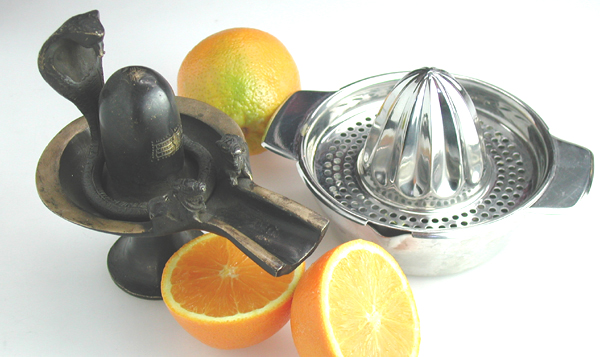

Related cartoon from the future (March 2007) by Mark Stivers.
Sacred, profane or mundane? The good Frater Holme's raison d’être is to demonstrate that "sacred" symbols percolate into [and out of] mundane and profane everyday objects.
So, top photo, yet another visual simile for your consideration - India's ancient sacred "Post/Vessel" Yonilingam with androgynous serpent, left, and on the right, a Supermarket version? For an explaination of this coital iconograph of Shiva's phallus and Pavarti's vulva, see Yonilingam basics with other reference images here.

Here, a recently discovered commercial iteration in the middle bars of our visual harmonic- to demonstrate that, indeed, popular culture continually extrudes the mythic!
Other visual affinities within this project: The Bucranium (Sacred Ox Head) and the Crucifix below, and the even more frightening Madonna Code.

18 November 2006
"Sacred vessels" ATOP Posts, Page 12
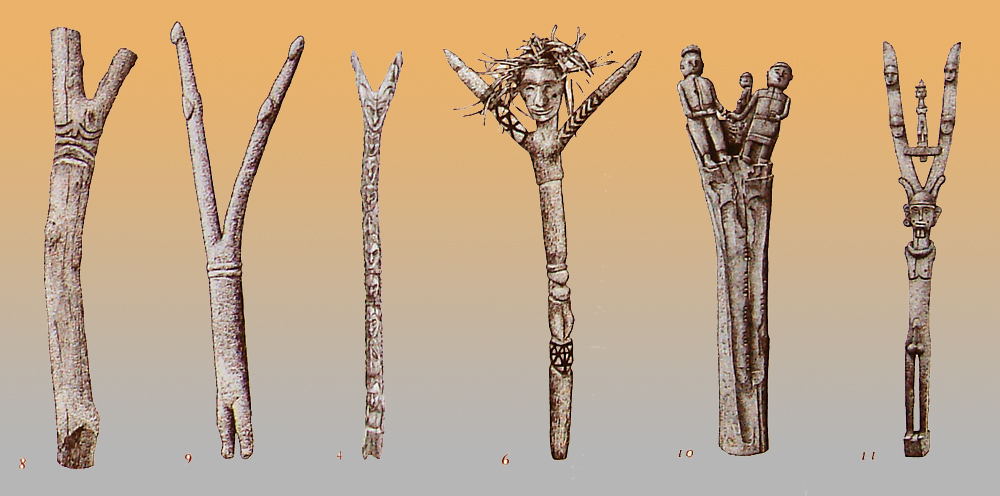
From Carl Schuster, 1996 - left to right: "Y-posts" from Hawaiian Islands; Mangarena; New Guinea; New Hebrides; Borneo; and Sumatra.
My thanks to Ami Ronnberg, Curator of the New York C.G. Jung Center's Archive for Research in Archetypal Symbolism (ARAS) who two weeks ago introduced me to Carl Schuster's twelve volume, 3500 page, 7000 illustration, Social Symbolism in Ancient & Tribal Art produced by Edmund Carpenter and generously "deposited. . .in 600 academic libraries" including the collections at ARAS. Fortunately for poor students, I have been able to find in Denver's Public (read: Plebeian) Library, Carpenter's abbreviated version of Schuster's huge efforts Patterns That Connect, 1996, Abrams, isbn 0810963264. Though Carl Schuster accepted research grants from Jung's Bollingen Foundation, Schuster's prolific "literary executor" (and defender?), Edmund Carpenter, considers Carl Jung as a lightweight "popularizer" (ibid. pg 8) responsible for "past foolishness" and spouting "jungian nonsense" (see bio by Carpenter and bio by Chicago's Field Museum.) But again, thank you, Ami!
While this novice observer sees the "Y-post" (illustration above) as a coital construct with vulvic "V" atop phallic post - the same as our prosaic wine glass - Carl Schuster equates the Y-post as (ibid. pg 14)- "the image of a tree with the branching of the human race. This correspondence between Tree & Genealogy lies beneath a wide range of cultures, in fact, Culture. Ultimately it rests on the analogy of plant propagation and the notion of human birth from budding."
"By its branching, the Tree symbolizes the Tribe, and thereby especially its ancestors to whom sacrifice must be brought. To me, the forked post is the symbolic reduction of the Tree (its use in connection with sacrifice, though important, merely extends its basic meaning as Tree)."
"This association of Tree & Genealogy dates from a least Upper Paleolithic times. What began, I assume, as a 'natural' metaphor, became- quickly, perhaps - an elaborate symbolic system that included limb-sharing ancestors, two-headed, joint-marked figures; and much more. There is nothing 'natural' about these systems: they are inventions, transmitted by word & practice." from Schuster / Carpenter's Patterns That Connect, 1996, Abrams, isbn 0810963264.
In his defense of Schuster, Carpenter points out that (paraphasing) "nothing about Carl Schuster's work evoked greater skepticism than his approach" which "excluded no relevant category of traditional culture," nor "data from diverse cultures, periods and continents". While their book, Patterns That Connect, does extend the Y-post motif to patterns on clothing, to "rebirth" gaming boards and ancient labyrinths, nowhere does Schuster's vast collections include obviously related (and I suppose, even less defensible) "everyday" Y-post motifs such as the Maypole, crucifix, wineglass or our cowboy boots atop posts. Perhaps the larger 3500 page version "deposited in academic libraries" includes the populist mundane - we will see on our next visit to academialand.
06 November 2006
Who is Asher'ah? Part Three: The Weavings

From Book of 2 Kings 23.7, NRSV, 3rd Ed., 2001 "[King Josiah] broke down the houses of the temple prostitues that were in the House of the Lord, where the women did weaving for Asherah." From the Jewish Publication Society's TANAKH, 1999, a transliteration of the Hebrew masoretic text "where the women wove coverings [Hb. batim] for Asherah." Raphael Patai, 1990, page 299 comments "The Septuagint [the early Hebrew Scripture translation to Greek, 300-100BC] [uses the Greek word]'stolas', that is, 'garments' for batim which may be based on an original badim, ie, 'linens'. The expression badim '(a person) clothed in linens' appears as a standing epithet for a mystical figure in Ezekiel 9 and Daniel 12." -from The Hebrew Goddess, isbn 0814322719
Recall that the general Deuteronomist's usage of an "Asherah" is a "sacred wooden post or pole", not the Goddess. Then the reference to women weaving linens within the precincts of Solomon's Temple for the sacred pole. Sounds a bit like Betsy Ross to me. So, is today's cover illustration of the American edition of "Newsweek", the weekly news magazine, a modern iteration of an ancient ritual? - the symbolic fabric wrapped around the symbolic pole - the ersatz female wrapped around the ersatz male - the image is too perfect. Keep it in mind for future blogs here. Please re-read the two earlier blogs - "Who is Asher'ah?" Part One in June 06 and Part Two in July 06. Newsweek cover illustration credit: photographer,Craig Cutler, 2006.
American voters, please do so tomorrow - for the world's sake.
Subscribe to:
Comments (Atom)
LinkWithin
